Multimedia
EUAC Engages in Policy Debate on Europe’s Frontier Countries
April 14, 2026
Ambassador Teimuraz Janjalia, Senior Research Fellow at the EU Awareness Centre, participated in a webinar hosted by the European Centre for International Political Economy that focused on the evolving geopolitical role of the European Union in its immediate neighbourhood.
The discussion examined how Europe’s frontier regions — including Eastern Europe and the Black Sea area — have moved from being perceived as a buffer zone to becoming a direct test of the EU’s ability to respond to geopolitical challenges in real time.
During the exchange, participants addressed the increasing complexity of the security environment, the role of external actors, and the growing importance of coordinated EU engagement in supporting stability, resilience, and democratic development in neighbouring countries.
Through its participation, EUAC contributed to the exchange on emerging geopolitical risks in the EU’s neighbourhood, with particular attention to hybrid threats and patterns of external influence.
EU Awareness Centre Participation in the Four-Part Webinar Series: Visegrad Lessons for Georgia — Overcoming Political Divides through Practical Cooperation
December 2025-April 2026
The EU Awareness Centre participated in a four-part webinar series “Visegrad Lessons for Georgia — Overcoming Political Divides through Practical Cooperation,” organised by the Caucasian Journal with the support of the International Visegrad Fund.
The series brought together policymakers, experts, and practitioners to examine how the experience of the Visegrad countries can inform Georgia’s approach to political polarisation, sectoral cooperation, and European integration. EUAC contributed actively across all four sessions through interventions by its leadership.
The EU Awareness Centre expresses its appreciation to the Caucasian Journal and its Editor-in-Chief, Alexander Kaffka, for organising this timely and substantive initiative, which provided a valuable platform for expert exchange on issues of direct relevance to Georgia and the wider region.
Part 1 — Political Differences, Practical Unity: The Visegrad Experience
George Robakidze focusted on the evolution of the Visegrad Group from an EU integration platform into a flexible mechanism for coordination and interest-based cooperation. He underlined that, despite weakening internal cohesion due to political developments in some member states, the V4 still demonstrates that meaningful cooperation is possible without rigid institutionalisation. In this context, he highlighted that for Georgia, the key lesson lies in pursuing pragmatic, interest-driven cooperation.
Part 2 — Academic and Scientific Cooperation; Environmental Challenges: Joint Responses
David Dondua emphasised the role of academic, scientific, and environmental cooperation as a form of “Track 2 diplomacy.” His intervention highlighted that such cooperation can remain resilient despite political tensions, helping to preserve dialogue, maintain European connectivity, and enable engagement even across conflict lines. The discussion explored practical mechanisms through which depoliticised sectors can sustain long-term cooperation in politically fragmented environments.
Part 3 — Business Beyond Politics
In this session, David Dondua addressed the resilience of economic cooperation in politically divided contexts. He stressed that strong institutional frameworks—particularly those linked to the European Union and the Single Market—can shield economic relations from political volatility. For Georgia, he highlighted the importance of rule of law, regulatory stability, and protection of property rights as key conditions for investor confidence, while also underlining the strategic importance of sectors such as transit, energy connectivity, and the digital economy.
Part 4 — Lessons for Georgia: Roundtable and Action Points
The concluding session brought together the main insights of the series. David Dondua emphasised that the central lesson of the Visegrad experience is the ability to sustain cooperation despite political differences. He highlighted the need to protect key sectors—including energy, infrastructure, education, and trade—from political polarisation, and stressed that Georgia’s progress depends on maintaining practical cooperation mechanisms even in a fragmented political environment.
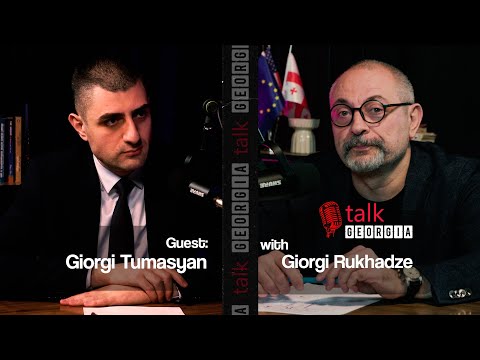
Talk Georgia Episode 32 – Guest: Giorgi Tumasyan
January 18, 2026
In this episode of Talk Georgia, EUAC research fellow Giorgi Tumasyan discuss the evolving dynamics of Georgian–Armenian relations and regional politics. Giorgi offers insights into how both countries are navigating geopolitical shifts and bilateral engagement. The conversation explores cultural, political, and strategic ties between Tbilisi and Yerevan, as well as broader implications for the South Caucasus. Listeners will gain a deeper understanding of cross-border cooperation and the challenges facing ethnic communities in the region.
“Freedom is the right to tell people what they do not want to hear”