

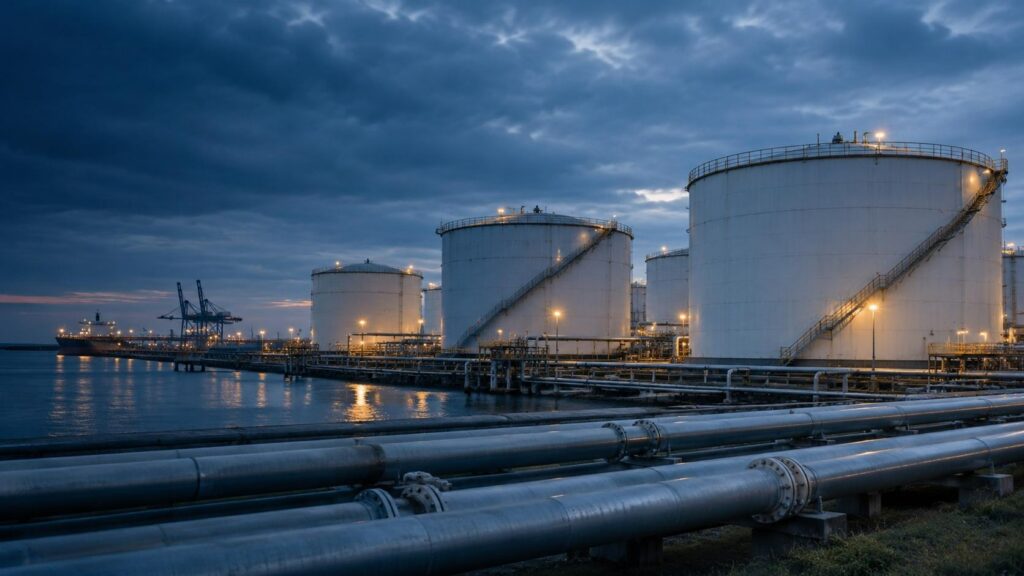
Georgia missed its 2023 deadline to implement European emergency oil-stock rules. A draft examined in 2025 proposed postponing a key stockholding decision until 2030. Meanwhile, Russia remained Georgia’s largest individual supplier of gasoline and diesel in 2026. This commentary examines what Georgia’s reporting gaps, Montenegro’s purchasing difficulties and the Energy Community’s new coordination group reveal about preparedness. It argues for stock-building plans that account for purchasing costs and test whether emergency fuel could actually be delivered.
Georgia was supposed to have European emergency oil-stock rules in place by 1 January 2023. Yet the Energy Community Secretariat’s November 2025 report still described a draft that would let the government wait until 2030 to determine the required stockholding level. That was a proposal, not an approved extension, and it did not mean the fuel would be in place by then. What is a deadline worth without a plan to buy the fuel?
Georgia’s obligation comes through the Energy Community, which extends parts of EU energy law to nine countries in the Western Balkans and Europe’s eastern neighbourhood. The EU Oil Stocks Directive requires emergency reserves equivalent to at least 90 days of average daily net imports or 61 days of average daily inland consumption, whichever is greater. The purpose is to keep essential services and the economy supplied when normal deliveries fail.
The Secretariat opened a formal case in 2024 over Georgia’s failure to incorporate the rules into national law. Its September 2025 assessment recorded a missing annual stock report and stock register. The November report added that monthly reporting was incomplete and no further progress had been made during the period assessed. These findings do not establish Georgia’s present stock levels. They show how difficult it was to assess its preparedness.
The uncertainty matters because Georgia depends heavily on imported fuel. In January–September 2026, Russia remained the largest individual supplier of gasoline and diesel, providing 279,800 tonnes, or 27.6 per cent of imports by volume. Romania supplied 15.2 per cent and Bulgaria 14.8 per cent. Georgia has alternatives, but replacing a major supplier at short notice is not the same as having fuel available immediately.
A supplier need not exert deliberate political pressure for this dependence to matter. Russia restricted gasoline exports in April to protect its domestic market; Georgian reporting linked the restriction to lower Russian shipments. No evidence shows it targeted Georgia. The relationship also carries a separate security dispute: the EU regards Russia’s continuing military presence in Abkhazia and South Ossetia as illegal. Emergency stocks would give Georgia time to arrange alternatives if deliveries were interrupted. The Secretariat’s 2025 assessment cannot tell readers precisely how many days of protection the country could count on.
Other countries show that adopting the legislation is only the beginning. At the Energy Community’s Oil Forum on 7 October 2026, officials reported that Serbia, North Macedonia and Montenegro had established oil-stockholding laws but held only about 45–50 days of emergency cover each, compared with the 90-day target. Much of the fuel still had to be acquired.
The next difficulty is paying for the fuel. Governments may know how many tonnes they need years ahead, but not what those tonnes will cost when purchases begin. A fixed budget can buy far less than expected if prices rise. Montenegro has already faced that problem.
Its April 2026 purchasing roadmap estimated that buying roughly 68,000 tonnes of planned state-held reserves would cost more than €80 million, about twice the earlier estimate. This concerned the state’s part of the stockholding programme, not the country’s entire obligation. Montenegro finances reserve-building partly through a three-cent-per-litre levy on petrol, diesel and liquefied petroleum gas, ultimately paid by fuel buyers.
The roadmap included a striking comparison. With €22 million available, Montenegro could buy about 31,500 tonnes at €700 per tonne, but only 17,000 tonnes at €1,300. These were planning scenarios, not completed purchases. The stockholding duty had not changed. What changed was how much protection the money could buy.
Georgia’s own trade figures offer a similar warning about costs, though not a calculation of its reserve bill. During January–July 2026, the value of commercial petroleum-product imports rose 32.7 per cent from a year earlier while volume increased only 8.7 per cent. Average import value went from roughly $751 to $917 per tonne. At those averages, an unchanged dollar budget would purchase about 18 per cent less fuel. Product mix may explain some of the difference, and these were ordinary imports, not emergency-stock purchases.
Purchasers cannot control market prices, but they can manage when and how they buy. Governments or fuel importers can spread purchases over time, use suitable supply contracts or, in some cases, hedge part of the price risk. Each approach has costs, and a financial hedge cannot guarantee physical delivery. A credible plan should explain what happens if the next tender exceeds its budget.
None of this excuses Georgia’s missed deadline. That legal failure predates the latest market shock and requires a legal remedy. But its neighbours’ experience shows why passing the law must be followed by financing, storage capacity and actual purchases. Delaying accumulation until a shortage would make an already difficult job harder.
Even fuel already counted as a reserve may need to travel. Montenegro’s Ministry of Energy said in March that approximately 41 per cent of its recorded mandatory stocks were held in Croatia and Greece. The ministry said it could withdraw them when required. Foreign storage is a legitimate arrangement. The operational question is how quickly those stocks could be released and transported during a disruption affecting several countries.
The Energy Community has a new forum for examining that question. On 7 October, it announced an Oil Coordination Group to share information, track supply risks and coordinate responses. The announcement did not establish a common reserve or oblige one government to supply another. The group could start with an exercise in which two neighbours face shortages at once: who authorises the releases, which routes are available and who pays to move the fuel?
National authorities and the Secretariat should make progress easier to judge. Alongside existing stockholding reports, they should publish how much qualifying fuel is held, how much of the remaining purchasing programme is funded and what has been tested about emergency delivery. For example, they could report how much fuel next year’s budget would still buy if prices rose by 25 per cent. Sensitive commercial and security details can remain confidential. The European Commission’s review of the Oil Stocks Directive offers an opportunity to consider technical and financing support; any change to Energy Community obligations would still require decisions through its own procedures.
Georgia should meet its obligation, not substitute another promise for the missed deadline. When fuel supplies are interrupted, a law cannot pay for a tanker, make storage available or clear a route across a border. Those arrangements have to exist before the crisis. That is what a credible emergency reserve requires.
The opinions and conclusions expressed are those of the author and do not necessarily reflect the views of the EU Awareness Centre.
© 2026 EU Awareness Centre. All rights reserved.