
The REPowerEU Dilemma: How the EU Helped Guide Hungary Toward a Greener Future
Download PDF
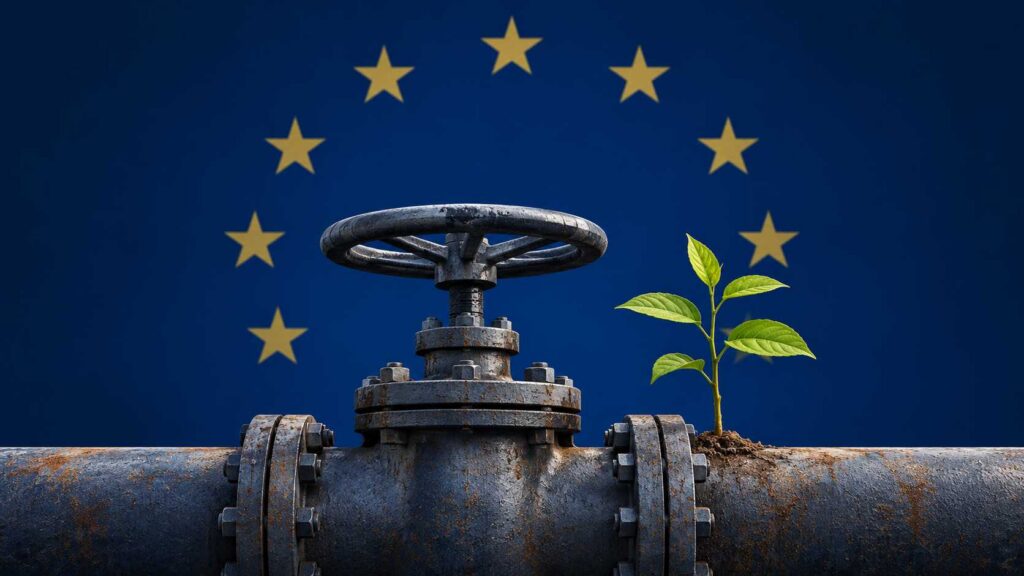
REPowerEU is the European Union’s plan to phase out Russian fossil fuels by 2027 while accelerating the shift to renewable energy. This opinion paper examines how Brussels is working to help Hungary achieve independence from Russian gas, weaken energy lobbies, and pave the way for a sustainable transition.
From the founding of the European Communities, a core aim, now inherited by the European Union, has been to guarantee citizens and businesses safe, economical and sustainable energy. To reiterate these principles, in May 2022 the European Union approved the REPowerEU plan, an energy plan focused on two main objectives: reducing the EU’s energy dependence on Russia as much as possible by 2027 while accelerating the transition to a green system based on clean and renewable sources. To turn this vision into reality, the EU planned to send significant financial resources to Member States to finance strategic energy projects.
Today, as Brussels celebrates the overall collapse of imports from Moscow and renewables overtaking imports in some European countries, part of Central and Eastern Europe still struggles to free itself from dependence on Russian gas pipelines.
This situation exposes a deep rift across the European continent, dividing Western European countries (which have managed the green transition and diversified suppliers) from Eastern European countries. Indeed, post-communist countries have a long history of environmental neglect and energy inefficiency, mainly because their economies developed for decades with total dependence on Russian gas. Added to this is the need to modernise obsolete infrastructure that struggles to absorb energy from clean sources today.
This mix of antiquated plants and strong historical ties with Russia makes the energy transition a decidedly arduous task for Eastern governments.
Field data confirm the complexity of this detachment. As research by the shows, even after Russia’s aggression against Ukraine, countries such as Hungary and Slovakia continued to be significantly dependent on Russian gas. Indeed, while the rest of the European Union reduced Russian pipe gas imports by 81% compared to pre-invasion levels, demand from Hungary and Slovakia fell by just 5.5%.
To understand the slow pace of the green transition in these countries (despite growing social pressures), I believe it is necessary to analyse the functioning and frequency with which Eastern European governments, particularly Hungary, interact with interest groups.
Let’s start with the question: what are interest groups?
These are formal (structured) organisations that put indirect pressure on the policy-making process. The activity of interest groups varies from country to country, and their effectiveness depends on dialogue with policymakers.
As highlighted by empirical research in the paper Towards energy policy corporatism in Central and Eastern Europe? (Horváthová, Dobbins, Labanino, Interest Groups & Advocacy, 2021), decision-making processes in some Eastern European countries (especially Hungary) suffer from a profound systemic imbalance.
Political dialogue is monopolised by powerful industrial and energy lobbies, leaving civic and environmental groups with extremely limited scope for action. This scenario has favoured the emergence of real strategic alliances between governments and large national energy companies, creating a model we can define as “crony capitalism”.
In this context, industrial giants such as the Hungarian company MVM act as “umbrella enterprises”: enterprises that, enjoying a privileged and almost exclusive channel of communication with the government, can steer public decisions to their advantage. Thus, a vicious circle is triggered: governments offer protection and economic aid to these organisations and in return receive political support.
As a result, environmental associations remain marginalised: despite having formal freedom to express themselves, they lack the institutional channels necessary to influence strategic decisions.
In this scenario, Brussels faced a dilemma regarding Hungary: should it send the energy transition funds, with the risk of them ending up in the clientelist networks of “umbrella companies”, or freeze them, with the risk of the Hungarian government using the blockade as propaganda to justify its dependence on Russian gas? And if it chose to freeze the funds, would this be an effective strategy to counter the model of “crony capitalism” typical of illiberal democracies?
After an initial period of uncertainty, the EU eventually decided to freeze European resources for the Budapest government through two main financial mechanisms. First, Brussels blocked funds under the Recovery and Resilience Facility (RRF), where disbursements depended on fulfilling strict judicial-independence and anti-corruption “super-milestones”. Second, Brussels triggered the Rule of Law Conditionality Regulation, which “aims to address breaches of rule-of-law principles that undermine the sound financial management of the budget or the protection of the Union’s financial interests” (Council of the EU), resulting in the suspension of billions in traditional cohesion funds.
In other words, this principle makes EU budget funds conditional on respect for the fundamental principles of the rule of law. In particular, before granting the funds, the EU expected Hungary to strengthen judicial independence and respect for fundamental rights.
The situation changed radically after Viktor Orbán’s electoral defeat and the inauguration of the new Prime Minister, Péter Magyar, in May 2026. He immediately began rapprochement with Brussels, leading to the release of European funds. On 13 October 2026, the Council of the European Union officially voted to lift the measures imposed on Hungary in 2022 under the Rule of Law Conditionality Regulation, thus releasing €4.2 billion.
This suggests that freezing funds through the Rule of Law Conditionality Regulation and the RRF functioned as an effective instrument of political and economic pressure. The effectiveness of lobbying by “umbrella companies” stemmed from the political protection the Orbán government granted them. As soon as this protection ended, the bureaucratic blockages hindering European plans collapsed within a few months, finally freeing up investment for a green transition.
In conclusion, the release of European funds marks the beginning of a decisive chapter for Hungary, but also of a profound responsibility for the new government. My wish for Prime Minister Magyar is that he should be able to move along two lines: on the one hand, to apply European resources effectively in order finally to modernise the country’s energy infrastructure; on the other, to open up the decision-making process to dialogue with interest groups that were previously marginalised, starting with civic and environmental associations.
In this way, it would be possible not to repeat the mistakes of the past and avoid falling back into the flawed mechanisms of crony capitalism.
Only where there is pluralism is there democracy, and only in a true democratic regime can the national good prevail over the particular interests of a few private individuals.
The opinions and conclusions expressed are those of the author and do not necessarily reflect the views of the EU Awareness Centre.
© 2026 EU Awareness Centre. All rights reserved.