Independent analysis on European policy, integration, and democratic governance.

This commentary examines the scale and mechanisms of Russian online influence operations in the context of Ukraine’s strikes on Russian Yandex data centres and the subsequent claims of declining bot activity. It questions whether disruptions to digital infrastructure can significantly weaken foreign influence and explores…

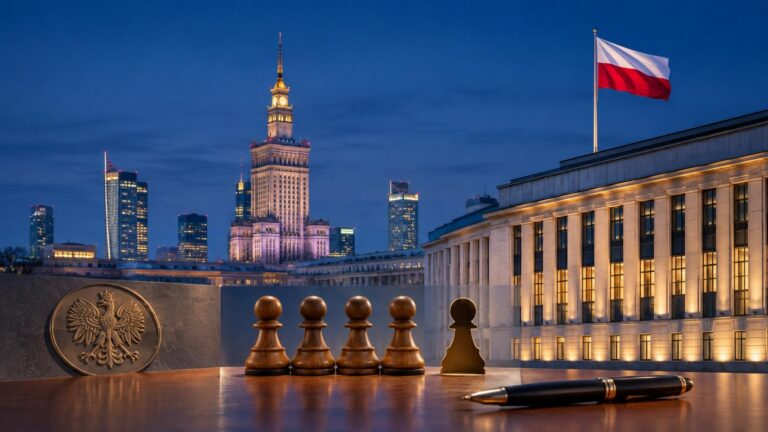
Poland's latest central-bank appointments have resolved a management-board staffing dispute while creating vacancies on the Monetary Policy Council. With parliament preparing to consider proceedings against governor Adam Glapiński, the reshuffle highlights a legal question: who can make binding monetary-policy decisions if the governor cannot participate?…


Recent bomb threats disrupting European flights, cyberattacks targeting civilian infrastructure and reports of unidentified drones raise questions about the strategic significance of seemingly isolated incidents. This commentary examines how operational disruption can become an instrument of subversion, exploiting vulnerabilities in human security to undermine public…


The EU’s disinformation strategy has built strong detection and institutional-response capacity, but it has left citizens’ critical-thinking skills underdeveloped: citizens report awareness of disinformation without necessarily being equipped to recognise how it works. Drawing on Eurosceptic rhetoric in Italy, this brief argues that disinformation is…


Cyberattacks on commercial refrigeration systems raise questions about the everyday dependencies that connect European societies. This opinion paper considers how shared vulnerabilities might contribute to a sense of European belonging, while distinguishing confirmed incidents from uncertain attribution and possible psychological effects. It argues that belonging…


Georgia missed its 2023 deadline to implement European emergency oil-stock rules. A draft examined in 2025 proposed postponing a key stockholding decision until 2030. Meanwhile, Russia remained Georgia’s largest individual supplier of gasoline and diesel in 2026. This commentary examines what Georgia’s reporting gaps, Montenegro’s…

In a 2025 interview with Radio Free Europe's Georgian Service, former Federal Security Service (FSB) Colonel and Russian opposition figure Gennady Gudkov provided insight into Russia’s influence campaign over Georgia.


On September 1, 2026, The New York Times published an essay by the distinguished Oxford historian Margaret MacMillan under a title that was difficult to ignore: “A New World Order Is Coming. We Aren’t Ready.” I read it with the utmost attention, armed with a…


Bulgaria’s new government enters office with something the country has lacked for nearly three decades: a clear parliamentary majority and an equally clear anti-corruption mandate. But with administrative corruption in 2026 at the highest level ever recorded, political will alone will not be enough. If…


Every generation inherits a country. More importantly, every generation leaves one behind. Politics, however, rarely encourages such long-term thinking. Public debate is usually consumed by immediate controversies, electoral cycles, tactical victories, ideological battles, and the endless urgency of the present moment. Too often, the preservation…

On 18 March 2026, the European Commission tabled COM(2026) 321 — a regulation that would create "EU Inc.", an optional corporate form sitting alongside the twenty-seven national company laws of the member states rather than replacing them. The initiative reflects a broader view in Brussels…


Across the European Union, media pluralism is under simultaneous pressure from two directions: state-driven capture—where governing majorities systematically dismantle editorial independence—and market-driven concentration —where a handful of conglomerates absorb the remaining outlets.

For many years, I believed that one of the most common mistakes made by small states was to mistake a change of administration in Washington for a change in America itself. Administrations come and go. Presidents come and go. Political fashions rise and fall. Institutions,…

Reading Victor Kipiani's recent essay on hedging, national interest, and the emerging international order, I found myself reflecting on many of the same questions. His observations are timely and thought-provoking. Yet they also led me to revisit several lessons that Georgia has learned - sometimes…

In this guest commentary for Almanach, Ambassador Tedo Japaridze reflects on Georgia’s search for legitimacy, strategic balance, and economic resilience through the lens of historian Paul Kennedy’s enduring analysis of power and survival. The article argues that for small states like Georgia, the central challenge…

In this guest commentary for Almanach, Ambassador Tedo Japaridze reflects on the growing debate surrounding neutrality in Georgia through the prism of great-power competition, democratic resilience, and small-state vulnerability. Drawing on the concept of the “Thucydidean Trap,” the author argues that for Georgia, the greatest…