
How a video tried to discredit a German election
The Claim
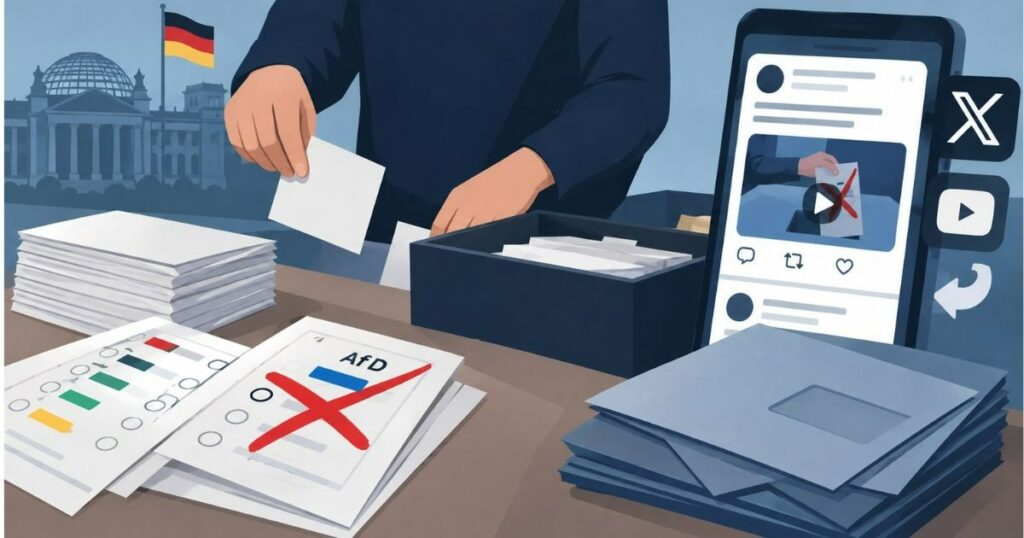
On 4 September 2026, two days before the state election in Saxony-Anhalt, a video began circulating on X claiming to show election fraud in Germany. In the video, a person opens what appear to be postal-ballot envelopes. Once an AfD candidate is selected, the ballot is set aside and marked with a large cross. Ballots marked for other parties are treated as valid. The accompanying message presents the footage as evidence that votes for the AfD are being deliberately removed.
The video quickly spread on X, Facebook, and TikTok. The posts claimed that election officials had been recorded destroying AfD ballots and had received more than 10,000 views by the time it was reported. Other English-language accounts had also amplified related material from the same influence campaign.
But one problem remained: the election documents shown in the video were not genuine.
The Fact
German fact-checkers compared the documents shown in the video with the official postal-voting documents used in Saxony-Anhalt and found multiple discrepancies. The ballot papers and envelopes shown in the video did not correspond to the genuine election materials.
The discrepancies were not minor details that an unusual local procedure could explain. The documents shown in the video differed from the official versions in several respects, including their design and numbering. Correctiv concluded that the material could not provide evidence of actual manipulation of postal votes. This matters because the video looks convincing at first sight. There is no obvious computer-generated imagery or spectacular visual effect. It shows an apparently ordinary election procedure: envelopes are opened, ballots are examined, and some are rejected.
The deception lies in something much simpler. The documents were made to look like election documents, but they were not genuine.
From a fake document to a false story
That is what makes the video more than an ordinary piece of false information. The footage takes a fabricated object and places it inside a believable scene. Viewers are told that AfD votes are being destroyed and are shown what appears to be visual evidence of it happening.
The effect is powerful because it encourages the viewer to draw the conclusion independently: If I can see it happening, it must be true.
The accompanying narrative then supplies the explanation: the electoral system is being used to prevent AfD voters from having their votes counted. It is a familiar form of election manipulation. Instead of trying to prove that one particular political position is correct, it casts doubt on the fairness of the process itself.
Who circulated it?
Strong evidence suggests the September circulation of the video was connected to the Russian-linked Storm-1516 influence operation. According to Correctiv, several high-reach English-language X accounts that distributed the video on 4 and 5 September had previously been identified as part of the Storm-1516 dissemination network linked to Russian military intelligence (GRU). The same accounts had circulated other false videos in the weeks before the election. Julia Smirnova, a senior researcher at the Center for Monitoring, Analysis and Strategy (CeMAS), assessed that the video was very likely part of the Russian campaign.
Nevertheless, the attribution should be kept separate from what can be established about the video itself. Evidence that the ballots were fake comes from comparing them with official election documents. The assessment that the video formed part of a Russian influence operation comes from examining its dissemination network and the behaviour of the accounts involved.
That distinction matters. Good fact-checking should not require a claim about the origin of disinformation to establish that the information itself is false.
Why target an election?
A fabricated story about stolen votes can do more than promote one political party. It can reinforce the belief that the political system is rigged, that elections cannot be trusted, or that voting itself is pointless. This does not mean everyone who shared the video intended to undermine democracy. Correctiv’s investigation found that some accounts involved in the earlier circulation of similar material appeared to be private individuals supporting the AfD.
But that is precisely why such narratives can travel easily. A sophisticated influence operation does not necessarily need every person who shares its material to know where it originated. A provocative claim can move from an organised network into genuine political communities, where people who believe it repeat it. The result is a chain in which the original source becomes less visible while the claim itself becomes more familiar.
The video offers a useful lesson that goes beyond this particular election. When confronted with apparently shocking visual evidence, the first question should not be “Who is behind this?” It should be: “What exactly am I looking at?” Are the documents authentic? Does the procedure correspond to the actual rules? Can the people, place and event shown in the video be independently verified? And who published the material first?
In this case, those questions are enough to break the story apart. The video appears to show genuine election workers destroying AfD votes. The documents are fake. The alleged act of election fraud therefore never happened as presented.
The manipulation was not only in the message. It was built into the evidence used to tell the story.
Think before you trust