
Change Our Minds, or Change Your Question?
What three Polish debate recordings reveal about arguments over the EU

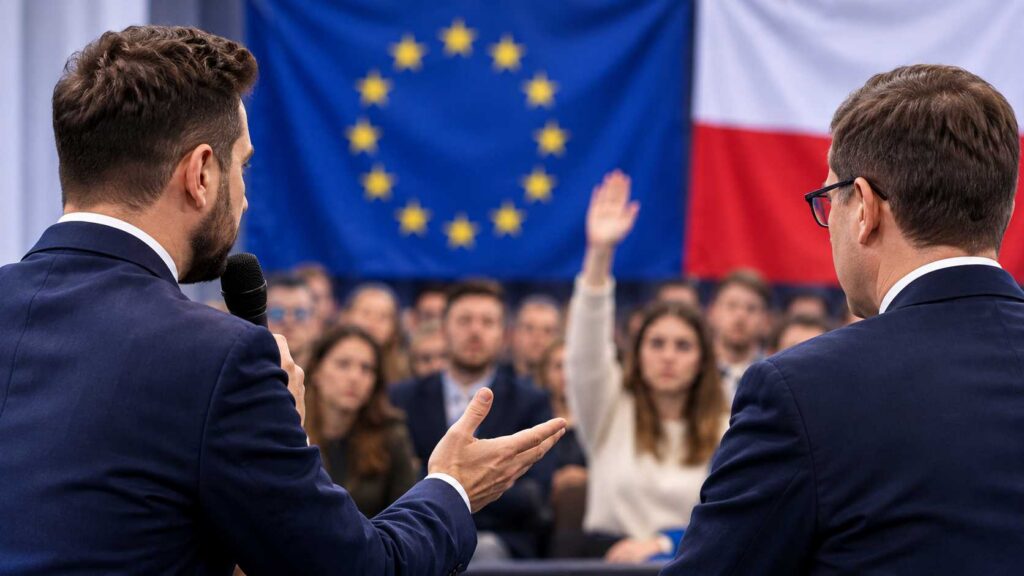
In 2026, two Polish MEPs invited students to challenge them in debates modelled on American campus activism. Although the audience often chose the topics, the politicians repeatedly reframed questions about EU policies as disputes over Brussels’s authority. Their party’s voters are split on membership but largely agree that the Union restricts Polish independence. That tension helps explain why Law and Justice answers no to leaving and moves quickly to sovereignty. The article argues that public debate should be judged not only by who speaks, but by whether it answers questions.
Questions from the audience
Polish MEPs Patryk Jaki and Tobiasz Bocheński spent several months in 2026 touring Poland with “Change Our Minds”, adapted from the campus-debate format popularised by American activist Charlie Kirk. The politicians stated their positions, then invited public challenges. Both are vice-presidents of Law and Justice (PiS), the right-wing party that governed Poland from 2015 to 2023 and now leads the opposition.
On 16 May, at an open microphone in Białystok, Jaki faced an objection to the wording of a referendum proposed on the European Green Deal. He said the referendum would free Poland from the Green Deal, which he described as detrimental to the Polish economy. Another participant asked, “Wasn’t it Morawiecki who brought in the Green Deal, by any chance?” Mateusz Morawiecki was PiS prime minister from 2017 to 2023.
“It’s complicated,” Jaki replied. He said other parties had designed the Green Deal while PiS had resisted it “heroically”, although it could have done more. Rather than clarify Morawiecki’s commitments, he advanced a legal claim: under the EU treaties, rules affecting a member state’s energy mix required unanimity, yet these measures had been adopted by majority vote. A minute later, someone asked whether the proposed referendum was “a first step” towards Poland leaving the EU. Jaki said no. He wanted Polish energy choices to remain outside Brussels’s control.
As OKO.press noted, PiS had set the tour’s overarching subject in advance: Poland’s future in the EU. But that did not mean the politicians chose every question. In Białystok, audience members introduced two difficult challenges within four minutes. The subtler advantage lay in the reply: the ability to redirect a question while appearing to answer it.
Poland makes the format revealing: EU membership enjoys broad support, a pro-exit party competes for votes, and the organisers published complete recordings.
One topic, three angles
Three questions are often nested within discussions around the Union.
- The first concerns policy: is a climate rule, loan scheme or trade agreement worthwhile?
- The second concerns authority: should Brussels or the national government decide?
- The third concerns membership: should Poland remain in the European Union at all?
These questions intertwine, as Białystok showed. The challenge began with the Green Deal and Morawiecki’s role in it. Jaki redirected it towards the legality of adopting the measures by majority vote. A question about membership followed, and he again returned to the limits of EU authority.
All three are legitimate subjects. The problem is shifting between them without acknowledging it. Political scientist Peter Mair argued in 2007 that the EU offers citizens few ways to oppose policies from within its system, so resistance to particular measures can become opposition to the Union itself.
These recordings make changes in direction visible, including who starts them.
Which question benefits PiS?
Poland’s political factions favour different versions of the European debate.
A January 2026 CBOS survey found that 82% of Poles supported EU membership and 14% opposed it. An “in or out?” question therefore favours both the pro-membership government and the pro-exit far right, for opposite reasons.
Law and Justice sits between the government and the far right. Among PiS voters, 70% support membership and 26% oppose it. Endorsing an exit would alienate most of its base; embracing the EU without qualification could push the quarter who want out to defect to further-right parties.
Yet, 71% of PiS voters agree that membership restricts Poland’s independence too much. These party-specific figures come from smaller survey subgroups, but suggest that sovereignty unites voters divided over membership. Those who want to stay can hear a promise to reform the EU from within; those who want to leave can hear firm opposition to Brussels.
This is an inference from the poll, not an admission by the politicians. It predicts a strategy: reject Polexit, then recast questions about European policies as questions about sovereignty and the limits of EU authority.
Reframing was not confined to PiS. On 15 March, three days before the Warsaw event, Prime Minister Donald Tusk called Polexit “a real threat today” after the president vetoed legislation for the EU’s SAFE defence loans. A dispute over EU funding had become an argument about leaving the Union. This article focuses on PiS because its politicians organised the debates being examined.
What the recordings show
Jaki’s YouTube channel contains full recordings of 22 events from February to October 2026, totalling about 39 hours. The figures below concern three: Warsaw, Poznań and Białystok. These were selected for contrast: the Warsaw stop attracted press coverage, the channel titled its Poznań recording a “sharp meeting”, and Białystok provided a later regional stop. All three took place between March and May; contentious events may be overrepresented, and the sample may not represent the other nineteen.
The author does not read or speak Polish. She cross-checked the English dubbing and captions on Jaki’s channel against a second English translation, produced by transcribing the Polish audio with Whisper and translating the resulting transcript with Claude Fable. She coded the exchanges herself, identifying speakers from the videos. Finally, a Polish speaker independently verified the machine-assisted translations against the audio.
Here, an “exchange” begins when a question or remark opens discussion of an EU-related subject and ends when that discussion moves on. A “shift” occurs when a speaker moves between policy, authority and membership within an exchange.
The audience set much of the agenda.
Of 31 EU-related exchanges at those three events, 21 began with someone other than a host. Jaki invited participants to propose their own theses; 11 of those 21 opened with a policy question. Across all subjects, audience members and the moderator mentioned PiS’s record in government 23 times. In Warsaw, the first student accused the politicians of coming “to shoot promotional material on an MP’s or MEP’s allowance”.
The hosts favoured another direction.
On 16 occasions, they shifted a question about a policy’s merits to Brussels’s authority to impose it. An audience member did so once; audience members moved the conversation back to the policy six times.
The Białystok Green Deal exchange was one example; two others follow:
- Discussing the EU’s SAFE defence loans, Jaki objected that Brussels could impose conditions or suspend funds. At an earlier stop, he had called the programme “a betrayal of Poland”.
- On the EU migration pact, he advocated Poland’s unilateral withdrawal, arguing that its adoption had breached the treaties.
The hosts also discussed costs. Seven times they returned to a policy’s effects, including Jaki’s claim that without the Green Deal everyone present could be as much as twice as wealthy.
Still, sovereignty was a versatile response: it worked across subjects, avoided disputes over detailed figures and diverted attention from PiS’s record. At Poznań, a participant confronted PiS with its part in the 2007 negotiations over the Lisbon Treaty, arguing that the agreement expanded EU authority. Jaki responded by referring to the earlier, abandoned Constitution for Europe and decisions of the EU’s Court of Justice.
None of this makes arguments over authority and sovereignty illegitimate. Whether Brussels can suspend a loan affects how good a deal it is, and if the EU treaties required unanimity for a measure adopted by majority vote, that would raise a legitimate legal objection. Under that reading, some of the 16 shifts are policy arguments in another form. Reclassifying the five loan-condition objections as policy arguments brings the count of shifts down from 16 to 11. The narrower objection is that arguments about EU authority sometimes displaced scrutiny of PiS’s own record. When a participant questioned Morawiecki’s role in bringing in the Green Deal, Jaki briefly defended his party before turning to the voting rules under which the measures had been adopted.
On Polexit, the hosts said no before returning to sovereignty.
Leaving the EU came up eight times across the three events, each time raised by an audience member or the moderator. In Warsaw on 18 March, the speakers held their event on the pavement outside a university that had declined to host them. After a lengthy discussion of defence loans, one questioner noted that Jaki was absent, then asked Bocheński whether PiS wanted to leave like Grzegorz Braun or stay like Sławomir Mentzen, two rivals further to the right.
Bocheński replied that only Braun and Prime Minister Donald Tusk spoke of leaving the EU. “We are not saying Polexit anywhere,” he said. “We governed for eight years and somehow we are still in.” He then argued that the EU Poland had joined was unlike the present Union: in his account, it had become more centralised and was taking powers from member states.
In Białystok, Jaki likewise said withdrawal was not in the party programme, favouring an EU focused on trade and economic cooperation with less say over domestic matters. In Lublin that October, he added a proposal for a referendum on Denmark-style opt-outs in justice, migration and energy.
Jaki also warned about the EU’s possible collapse. Twice in Białystok (not counted among the eight mentions above), he suggested that an unwilling Union would eventually fall apart on its own. Elsewhere, Jaki said the government was bringing Polexit “closer than we think”. In these examples, exit was presented as a result of others’ actions, not PiS’s preferred policy.
The most common audience question asked whether an EU policy was good for Poland. The hosts often answered by questioning Brussels’s authority. With Polexit politically awkward for PiS, this framing let the party emphasise sovereignty without endorsing withdrawal.
Conclusion
The recordings challenge the idea that whoever controls a debate platform necessarily controls its questions. Participants pressed PiS on its time in government, the costs of EU measures and the possibility of Poland leaving the Union. The organisers chose the setting, but the public raised challenges that weren’t always convenient.
The speakers had greater freedom over what followed. A question about whether a policy worked could prompt an answer about Brussels’s right to adopt it. Asked about Polexit, the MEPs rejected withdrawal and then returned to EU overreach. This position, opposing greater EU power without advocating exit, could accommodate PiS supporters who disagree over membership.
That does not mean every appeal to legal authority evades the issue. Such arguments can be central to judging a policy. What matters is whether the focus shift is acknowledged and whether the original challenge is addressed. An open microphone is not, by itself, an adequate test of public debate. If a loan cannot be discussed on its merits, the discussion may keep returning to the Union itself, while the question that prompted it remains unanswered.
The opinions and conclusions expressed are those of the author and do not necessarily reflect the views of the EU Awareness Centre.
© 2026 EU Awareness Centre. All rights reserved.