
Europe’s New Migration Policy: Where Do Border Controls End and Human Rights Begin?
Download PDF
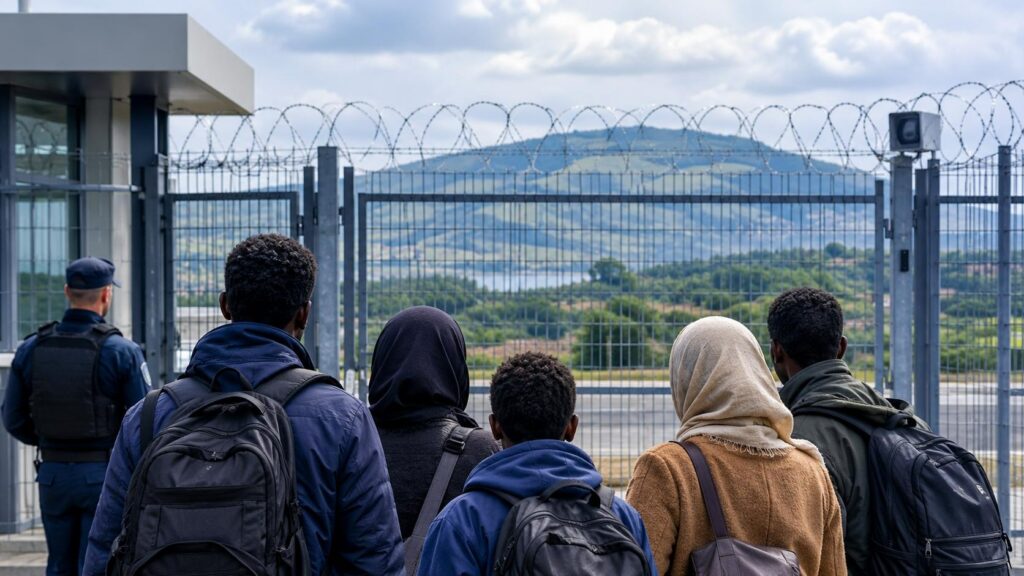
On 16 November in Vienna, Austria, Denmark, Germany, Greece and the Netherlands announced plans to set up a return hub in Rwanda. It would be the first EU facility of this kind outside the Union. The move shows how far Europe’s migration debate has shifted after years of disagreement over asylum, borders and the return of people who have no legal right to stay.
Governments are under pressure to show that asylum decisions have consequences and that rejected applicants can be returned. Yet the plan raises basic questions about legal responsibility, human rights and the limits of cooperation with countries outside the EU.
The real question is not whether policy should be stricter or softer. It is whether Europe can make returns work without weakening the legal principles on which its asylum system rests.
Why Europe is changing its approach
Migration has been one of Europe’s most sensitive political issues for more than a decade. The 2015 arrivals exposed weaknesses in the EU’s asylum and border systems. Disputes over sharing responsibility among Member States, and difficulties in returning rejected applicants, have kept the issue at the top of the agenda.
For many governments, the credibility of asylum policy depends on whether decisions are carried out. In practice, returns are often hard. Countries of origin may refuse to take back their nationals, people may lack travel documents, and legal or practical obstacles delay removal. According to the Council of the European Union, around two in three people ordered to leave the EU do not actually leave.
Domestic politics adds pressure. Parties with restrictive positions on immigration have gained influence in several countries, pushing governments across the political spectrum to rethink their policies.
What are return hubs?
A return hub is a facility in a non-EU country to which people with no right to stay in the EU can be transferred. They stay there temporarily while their return to their country of origin is organised, or while they consider other options.
The EU’s new Return Regulation, adopted by the Council on 1 October 2026, gives Member States a common legal basis for such arrangements. Partner countries must respect international human rights standards, including the principle of non-refoulement. Unaccompanied minors are excluded. Families with children, however, are not, a point that has drawn criticism from refugee organisations.
The Vienna initiative is the first attempt by a group of Member States to use this framework. According to the Dutch government, the hub is meant for people whose return to their country of origin cannot be carried out. The first phase would involve single men. The facility would be open, not a detention centre, and those transferred would receive residence rights and access to education, healthcare, work and the courts in Rwanda.
The pilot would hold around 100 people at a time, according to Reuters, with transfers planned from 2027. No agreement has been signed yet. Key questions — the legal arrangements, monitoring, costs and who is legally responsible for the people in the hub — are still under negotiation.
The idea is not entirely new. Denmark signed a migration memorandum with Rwanda as early as 2021, and the Netherlands signed a letter of intent with Uganda in 2025. Officials describe the Rwanda hub as a pilot, with further arrangements to follow.
The arguments in favour
Supporters argue that the current system does not work well enough. If a fair asylum procedure finds that a person has no right to stay, but returning to the country of origin is impossible, a third-country option may seem practical.
They also argue that credible returns could discourage irregular migration. If a rejected claim does not mean staying in Europe anyway, fewer people may risk dangerous journeys. Whether this deterrent effect works in practice is still unproven.
Finally, public trust is another concern. When rules are not enforced, citizens lose confidence in the institutions that manage migration, and polarisation deepens.
These arguments deserve serious consideration. An asylum system cannot function if its decisions are routinely ignored. The right to seek international protection is not the same as a right to stay after a claim has been finally rejected.
The legal and humanitarian questions
The central question is whether people can be sent to a country with which they have no connection in a way that fully respects their rights.
The key principle is non-refoulement: no one may be sent to a country where they face persecution, torture or other serious harm. This covers not only returns to a country of origin but also transfers to a third country that could send the person on to danger. A rejected asylum claim does not remove these protections. Individual circumstances must still be assessed, and access to effective legal remedies must be guaranteed.
This is why Rwanda’s record matters. The country hosts refugees and is willing to cooperate with Europe. But in November 2023, the UK Supreme Court, in R (AAA) v Secretary of State for the Home Department, found the UK’s earlier Rwanda scheme unlawful. The court found a real risk that people could be sent on to countries where they would face harm. It relied partly on evidence that people transferred to Rwanda under an earlier arrangement with Israel had been moved on to other countries. The UK scheme was different — asylum claims were to be processed in Rwanda, while the EU plan concerns people whose procedures are already complete. Still, the ruling directly affects how much weight Rwanda’s assurances carry. Human Rights Watch has questioned whether Rwanda can meet the new EU framework’s standards.
The Council of Europe’s Commissioner for Human Rights has called for strict safeguards: full human rights risk assessments, independent and continuous monitoring, legally binding agreements with enforceable protections, and public and parliamentary scrutiny. Compliance, in other words, must be shown in practice, not only promised.
The UN High Commissioner for Refugees took part in the Vienna discussions and offered to advise on the safeguards any arrangement would need. This matters: the question is less whether cooperation with third countries is possible than under what conditions it can be lawful, safe and sustainable.
Migration as a weapon and a narrative
The debate also has an often-overlooked security dimension. In 2021, Belarus deliberately moved migrants towards the borders of Poland, Lithuania and Latvia. In 2023, Finland closed its border with Russia after Moscow directed asylum seekers towards it. In both cases, migration was used as a tool of pressure against the EU.
Migration is also a favourite theme of foreign information manipulation. Hostile actors amplify narratives about a Europe that has lost control of its borders, or one that has abandoned its values, to deepen division. A return policy that fails in practice feeds the first narrative. One that breaks the law feeds the second. Getting both effectiveness and legality right is therefore also a matter of Europe’s resilience.
A European policy or a political signal?
With around 100 places, the Rwanda hub cannot by itself fix the EU’s return problem. The number of people concerned is far larger, and the obstacles to return differ from case to case. Its political significance may therefore outweigh its practical impact: it shows that several governments are ready to try arrangements once seen as legally or politically out of reach, and others may follow.
But a policy should be judged by its results, not by the message it sends. If people are moved to Rwanda but still cannot be returned home, the problem is simply relocated. If safeguards are weak, years of litigation may follow and confidence in the asylum system will suffer. And if the costs outweigh the benefits, the whole approach will be questioned.
Precedents give reason for caution. The UK abandoned its Rwanda plan after the 2023 ruling. Court rulings have held back Italy’s centres in Albania, which have operated far below capacity. The new plan differs in important ways, but political agreement alone has not solved the legal and practical problems before.
The test for Europe
Europe has a legitimate interest in controlling its external borders, running functioning asylum procedures and enforcing lawful return decisions. None of these conflicts with human rights. A fair, predictable, and effective system can strengthen public support for protecting those who truly need it.
But cooperation with third countries must not become a way of moving legal responsibility outside the EU. Member States remain bound by European and international law, including when they act through agreements with others. Reports that the five governments may keep legal responsibility for people in the hub are encouraging — but this must be written into a binding agreement, not left to political statements.
The success of the Rwanda plan will depend on details not yet settled: the legal status of those transferred, their living conditions, independent monitoring, access to legal aid, and what happens if return home proves impossible.
Europe’s migration debate is often framed as a choice between control and compassion. That is a false choice. Effective border management and respect for fundamental rights are both part of a credible European policy. The Rwanda hub will show whether Europe can manage migration as a community of law, or only as a policy of deterrence.
The opinions and conclusions expressed are those of the author and do not necessarily reflect the views of the EU Awareness Centre.
© 2026 EU Awareness Centre. All rights reserved.