
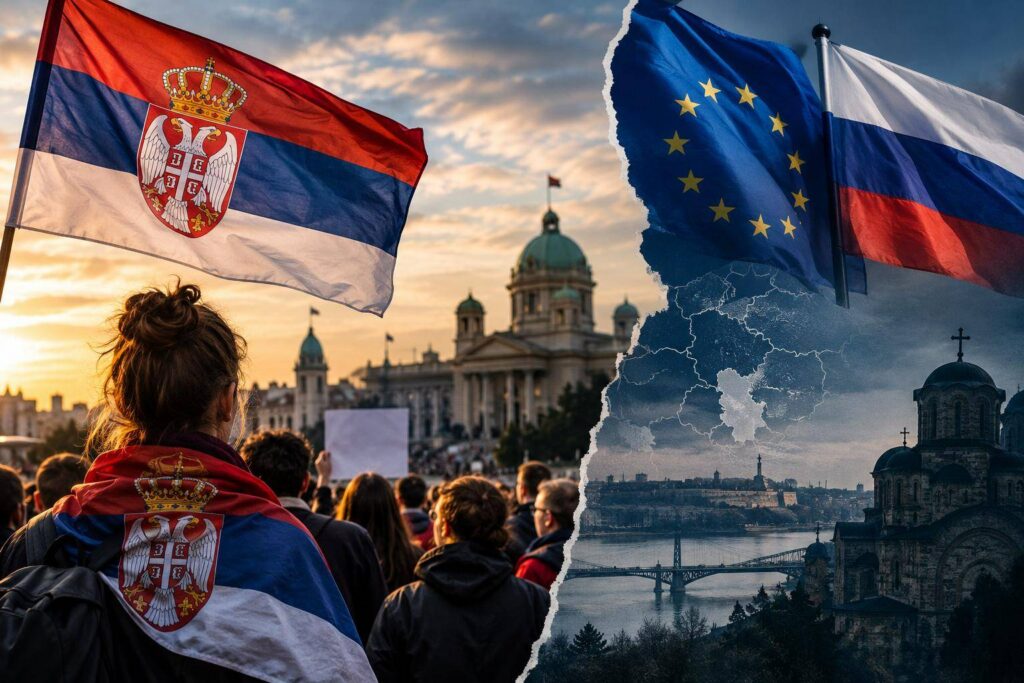
Aleksandar Vučić’s electoral defeat is a watershed moment in Serbian politics. He stepped down as president in September to run as the SNS list’s candidate for prime minister. On 25 October he was voted out. The Student List (which emerged from nearly 2 years of student protests) took 52.65% of the vote compared to 39.2% for the SNS list (figures from the electoral commission’s count of approximately 97% of polling stations). With around 140 of the 250 seats it can govern on its own. It is the end of 14 years of SNS rule.
The outcome is certainly a cause for hope in terms of democratic renewal. The implications for Serbia’s foreign policy however are far from clear. A movement which is united in its opposition to corruption and political patronage will now have to decide just how far it is willing to go in terms of altering the country’s approach to the EU, Russia and Ukraine. With an outright majority it will have no coalition partners to share the burden of those decisions.
Mass protests erupted in Serbia following the collapse of a railway station canopy in Novi Sad in November 2024 which resulted in 16 deaths. What followed was far more than just a reaction to a terrible accident. Students demanded accountability, transparency, and the rule of law. The protests also brought with them a huge number of citizens who were fed up with the concentration of power in the hands of a few and the state of the democratic institutions.
The very nature of the movement meant that its success was by no means guaranteed. It was not an opposition party in the traditional sense with a clear leadership structure and a track record of electoral success. The students themselves chose the candidates (mostly experts and professors) and even after the vote there was no prime minister nominee. Its lack of centralised structure and its refusal to align itself with any of the established parties had been a major factor in its appeal to a broad cross-section of the population. There were of course doubts as to whether it would be able to translate the energy of mass mobilisation into a viable political programme. It has now crossed the first hurdle. Governing will be the real test.
A democratic mandate, but for what foreign policy?
The Student List’s strength has always been its ability to bring together people of all political stripes around a common domestic agenda. The programme is all about judicial independence, anti-corruption, transparent public procurement and media freedom. All of these are very much in line with Serbia’s path towards Europe, but it’s not a clear-cut statement of commitment to EU membership.
Democratic reform and European integration are closely related, but they are not identical. A political movement can demand accountable institutions while remaining divided over relations with Brussels, Moscow and other international partners. During the campaign, the students deliberately kept foreign policy off-centre on their platform, arguing that domestic reform must come first.
Their plan for the EU is very clear on this point. The list’s representatives would go ahead and carry out the internal reforms and close the negotiating chapters first, before putting the question of membership to the people in a referendum. Some of the candidates have actually said they would have such a referendum in place within six months of taking office. A referendum could lend greater legitimacy to EU membership and could also be used to slow down or indeed stop the process of accession altogether.
Kosovo is another test. The list opposes recognising Kosovo’s independence, pointing to the Serbian constitution, which describes Kosovo as part of Serbia. Some candidates have also proposed reviewing the agreements reached with Priština under EU auspices. This raises questions about how quickly relations with the EU could improve.
The new government will have to work out what its priorities are as it manages the expectations of the electorate who have voted for it for all sorts of reasons. It’s a chance for change, but it’s not a blank cheque in terms of where it wants to go on the geopolitical front.
Russia, Ukraine and the paradox of Vučić’s policy
The relationship with Russia is the real test. Vučić has been in close touch with Putin and has refused to join the Western sanctions against Russia following its full-scale invasion of Ukraine in February 2022. The reasons for this are of course historical, cultural and religious (Serbia’s links with Russia), energy dependence and Moscow’s support for Kosovo.
Vučić’s approach was more complicated than just a straightforward alignment with the Kremlin. Serbian arms did in fact get to Ukraine via third country intermediaries even though Belgrade would not provide direct military assistance. The Financial Times in June 2024 gave an estimate that some €800m worth of Serbian arms had made it to Ukraine via these routes since the start of the full scale invasion. That didn’t make Serbia a military backer of Ukraine by any means, but it did highlight the extent to which its neutrality was in fact limited.
The new majority have no intention of altering their position on sanctions. On 30th September the student movement stated that Serbia would maintain its position of not imposing sanctions on Russia, pointing out that sanctions don’t address the underlying political and security issues. They have also called for a reduction in Serbia’s energy dependence on Russia. The list is a truly cross section of the political spectrum and not everyone on it is in agreement as to how close the relationship with Moscow should be. A change of government in a democracy should not therefore be interpreted as an automatic geopolitical shift.
Arms exports add another layer of complexity. The various candidates on the list have all stated that Serbia should cease selling arms to countries in which wars are being fought. As per Reuters, such a ban could also apply to Western countries who are passing arms on to Ukraine. The list has not yet laid out a specific policy on this. The exact scope of such a policy will be important as a blanket ban on arms exports to any country in a state of war is not the same as a policy specifically targeted at Ukraine.
The paradox is quite stark really. A movement positioning itself as a democratic alternative to Vučić could effectively close off a route through which Serbian weapons have been getting to Ukraine, even as it seeks to move closer to the EU. For Kyiv the issue will be less about the rhetoric of change and more about what decisions Belgrade ultimately makes.
The difficult choices lie ahead
The new government will face substantial constraints. Serbia depends on Russian gas, has close economic relations with the EU and must manage the unresolved issue of Kosovo. Its leaders will also have to reconcile public expectations with the practical requirements of European integration.
The political fight is far from over. Vučić’s SNS is still the largest opposition force with some 100 seats. The Speaker of Parliament, Ana Brnabić, has been acting President since Vučić’s resignation and a presidential election is still to be held. The new majority will have to govern in the meantime whilst that election is being fought.
Moscow will also not stay passive. Russia has long used Serbian media and social networks to present itself as Serbia’s only reliable friend and the EU as a hostile power. The new government will likely frame every decision on sanctions, Kosovo, or arms exports in that way. Serbia’s democratic opening will also be a target for information manipulation.
A complete break with Moscow is not going to happen overnight. The EU shouldn’t simply write off democratic change in Serbia just because the new leadership hasn’t gone along with every aspect of the EU’s foreign policy. The real question is whether Serbia will actually strengthen its institutions, rebuild public confidence and establish a more predictable relationship with its European partners.
For the EU the opportunity is obvious, the challenge equally so. To support democratic reform in Serbia does not in any way imply that the new government will automatically be pro-EU. There must be clear expectations as to the rule of law, media freedom, the position on Kosovo and alignment with the EU’s foreign and security policy.
Serbia’s political transformation has opened a new chapter. Whether it also changes the country’s place in Europe will depend on how the movement uses its mandate: on sanctions, arms exports, Kosovo, and the referendum it has promised. Winning the election was the easier part.
The opinions and conclusions expressed are those of the author and do not necessarily reflect the views of the EU Awareness Centre.
© 2026 EU Awareness Centre. All rights reserved.