
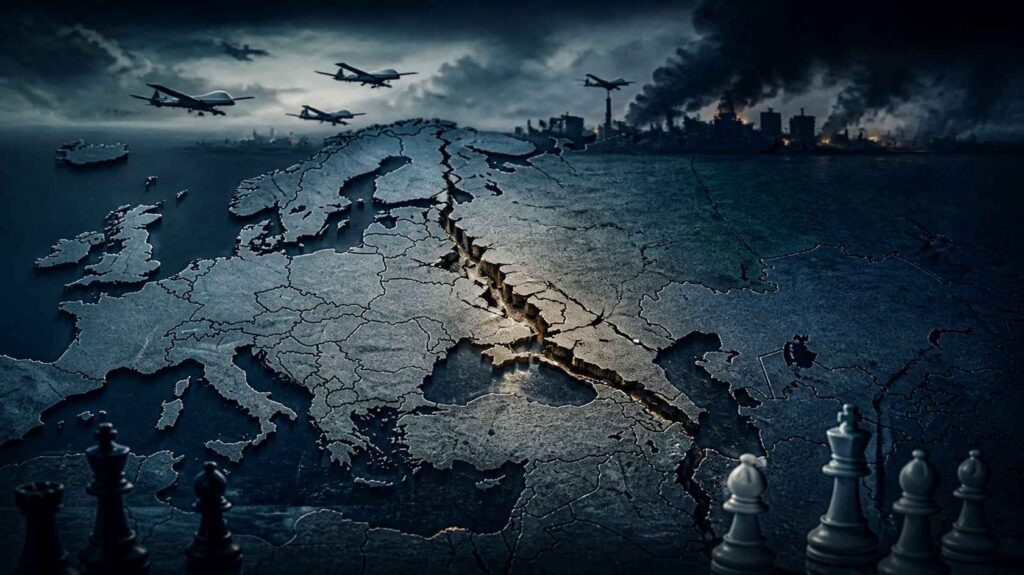
The prolonged war in Ukraine has irrevocably dismantled the post-Cold War illusion of permanent European stability, signaling a definitive return to industrial-scale warfare and unapologetic great-power competition. For decades, the dominant Western strategic paradigm rested on the principles of liberal internationalism, the assumption that deep economic interdependence, free trade, and integration into global financial institutions would inherently pacify authoritarian states and tether them to the rules-based order. This conflict has proven that doctrine is in deep crises. The occupation and following annexation of sovereign territory of Ukraine in 2014, has transformed into a systemic rupture of the global architecture. The initial Western belief that economic sanctions and diplomatic isolation would swiftly force an authoritarian capitulation severely misjudged the resilience of a command-style war economy. Instead, the conflict validates classical neorealist theories: in an anarchic international system, state survival, security dilemmas, and hard power dynamics dictate behavior, decisively eclipsing the institutional idealism of the post-1989 era.
In this new geopolitical reality, diplomatic and legal frameworks, once viewed as genuine, unique and binding mechanisms for conflict resolution, have been systematically degraded. Revisionist powers now weaponize the vocabulary of international law, utilizing institutional vetoes, procedural delays, and selective interpretations of sovereignty not to resolve disputes, but as tools for asymmetric power projection. The fundamental assumption that the international community shares a collective interest in preserving the status quo has collapsed. Hostile states no longer seek gradual inclusion within the Western-led global economy, they actively seek its structural dismantling.
As the war in Eastern Europe grinds into a brutal, protracted phase of industrial attrition, overlapping global crises have demonstrated that this assault on the international rules-based order is neither isolated nor uncoordinated. The expanding kinetic conflicts involving the United States, Iran, and Iranian proxy networks in the Middle East have acted as a massive strategic diversion. By fragmenting Western military resources, drawing critical air-defence assets and artillery munitions away from the European theater, and inducing volatility in global energy markets, these “secondary” conflicts have actively relieved macroeconomic and diplomatic pressure on Moscow.
This environment of global political “contagion” has catalysed a rapid and historically significant realignment of alliances, crystallizing what security analysts now term an “Axis of Upheaval”. This multipolar axis, driven by the deepening strategic, economic, and military convergence of China, Russia, Iran, and North Korea is actively collaborating to exploit the structural vulnerabilities, divided attention, and political fatigue of Western democracies. While not a formal treaty alliance, this coalition is united by a shared, revisionist objective: to diminish U.S. global hegemony, uproot Western influence, and rewrite the global security architecture.
By pooling their respective advantages, exchanging Chinese dual-use technologies and Iranian drone manufacturing for heavily discounted Russian hydrocarbons and nuclear cooperation, this authoritarian bloc has insulated itself against Western economic coercion. Utilizing a combination of asymmetric warfare, supply-chain weaponization, and nuclear blackmail, they have successfully ushered in a highly volatile, transactional multipolar order. Consequently, the West is no longer simply managing a regional European crisis, it is locked in a generational struggle to preserve the viability of democratic deterrence worldwide. Partnership interaction of the US with such actors, are bringing only uncertainty and division of democratic world. If systemic changes are not made, negative and painful results will occur for the West soon, if they have not already.
Ukraine: The Crucible of Resistance and Demographic Exhaustion
After years of devastating conflict, Ukraine’s survival is defined by a precarious balance between extraordinary grassroots civic resilience and the immense, compounding human tragedy of protracted warfare. From the outset of the full-scale invasion, the Ukrainian military recognized that it could not match Russian raw artillery mass or armored reserves in a symmetric, head-on confrontation. Instead, Ukrainian armed forces fundamentally changed modern combat. They deliberately moved away from the rigid, heavily centralized, and top-down Soviet military doctrines that plague their adversaries, adopting instead highly decentralized, agile command structures. By empowering junior officers and non-commissioned officers to make rapid, localized decisions based on real-time intelligence, Ukraine introduced an unprecedented level of operational flexibility to the European theatre. Facing a numerically superior adversary, Ukraine’s most critical survival mechanism has been the rapid leveraging of asymmetric technological innovation. The battlefield has served as a crucible for the integration of commercial and military hardware, most notably through the mass deployment of first-person view drones, heavy quadcopters, and fixed-wing strike platforms. Furthermore, Ukraine has pioneered algorithmic warfare through deep integration with commercial tech partners. Systems like the domestically developed situational awareness networks, long range offensive products and advanced AI platforms have revolutionized targeting capabilities. These AI-driven software suites aggregate terabytes of data from satellite imagery, drone feeds, and localized sensors into a unified operational picture, accelerating the “kill chain” to allow Ukrainian artillery and drone operators to strike targets in minutes rather than hours. This asymmetric doctrine have been devastatingly effective towards oil production facilities, deep in the territory of Russia and in the maritime domain. Despite possessing virtually no conventional navy at the start of the war, Ukraine systematically neutralized the Russian Black Sea Fleet, historically a primary pillar of Russian power projection. Through the mass deployment of domestically manufactured autonomous maritime surface vessels, paired with Western-supplied long-range precision missiles, Ukraine successfully destroyed or heavily damaged a massive portion of Russia’s Black Sea combat assets. This forced the remnants of the fleet to abandon its primary base in occupied Crimea, retreating further east to Novorossiysk.[1] However, the long-term perspective for Ukraine remains highly precarious, dictated by inescapable biological, infrastructural, and economic realities. The systematic, continuous destruction of Ukraine’s civilian infrastructure, particularly its thermal and hydroelectric generation capacity, subjects the population to brutal physical and psychological attrition.[2] Throughout the harsh winters, including the extreme 2025–2026 heating season, Russian forces continue to launch hundreds of coordinated strikes against combined heat and power plants, high-voltage substations, and transmission networks at present as well, thus creating very challenging economic and social situation before the winter season.[3] These attacks are not going to be stopped and the main goal is to deliberately induce massive generation deficits, plunging cities into darkness and freezing temperatures, while stripping high-rise urban centers of essential water and sanitation services. Moscow’s strategy is expressly designed to break societal resolve, collapse the economy, and force mass civilian displacement. Furthermore, Ukraine faces hard demographic limits. The mobilization pool is severely strained as the country confronts the physical exhaustion of its frontline troops and a staggering displacement crisis. With nearly a quarter of its pre-invasion population, up to 10 million people, living as refugees abroad or internally displaced, the labour force required to sustain both the war effort and the domestic economy is critically depleted.[4] Concurrently, the state economy operates almost entirely on a lifeline of Western macroeconomic support to fund basic social services and state salaries, while domestic revenues are entirely consumed by military defence. Compounding this internal exhaustion is the growing geopolitical threat of external fatigue. There is mounting pressure from certain Western political factions, fearful of escalation, domestic economic woes, or prolonged defence expenditures, to force a diplomatic freeze along, Russian-preferred battle lines. For Kyiv, this presents an existential threat. A ceasefire without robust, enforceable security guarantees specifically, full military protection, or heavily armed, binding bilateral treaties, would merely serve as a tactical pause. As history demonstrated with the failed Minsk agreements, Moscow routinely utilizes such ceasefires to reconstitute depleted units, rearm its mobilized forces, and prepare for subsequent, more brutal offensives. Ultimately, Ukraine’s ability to withstand this crushing dual pressure, the internal exhaustion of its people and grid, paired with the external geopolitical fatigue of its allies, remains the central, defining variable of the war.
Russia: Authoritarian Resilience and the Total War State
Contrary to early Western expectations, the Russian state has proven remarkably resilient to unprecedented international economic blockades. The initial sanctions regime, while structurally damaging over the long term, failed to trigger the anticipated collapse of the Russian economy or provoke a domestic political uprising. Instead, the Kremlin successfully transitioned into a command-style war economy, utilizing a profound form of “military Keynesianism” to artificially inflate domestic growth, maintain high employment, and shield the populace from the immediate economic fallout of the conflict. By redirecting massive federal reserves into defence production and offering unprecedented salaries and death benefits to contract soldiers, a phenomenon some sociologists have dubbed “deathonomics”, the Kremlin has actually elevated the economic standing of Russia’s most impoverished, peripheral regions.[5] This massive wealth transfer has temporarily stabilized domestic approval and incentivized continuous voluntary recruitment, masking the devastating human cost of the war beneath a veneer of wartime prosperity. The recent electoral cycles in Russia confirmed an entirely calcified, autocratic political landscape. The regime has systematically dismantled all internal opposition, criminalized anti-war dissent, and transitioned the state into a permanent mobilization footing. The Kremlin’s strategic doctrine now views the subjugation of Ukraine as an existential necessity, meaning internal political change is highly improbable without a catastrophic battlefield defeat. The political and economic elites are now so deeply intertwined with the war effort that a sudden cessation of hostilities would threaten the very economic engine currently keeping the state afloat. To bypass Western export controls and sustain this war economy, Russia has constructed a sprawling, highly effective shadow logistics network. It has successfully utilized illicit financial flows, which surged into the tens of billions of dollars across the Caucasus, Central Asia, and the Western Balkans, to evade technology embargoes. Through shell companies, falsified documentation, and rebranded entities, Moscow continues to secure the critical microelectronics, semiconductors, and dual-use components required for its defence sector. This logistical lifeline is heavily underwritten by Russia’s “shadow fleet” of ageing oil tankers, which allows Moscow to circumvent G7 price caps. By redirecting oil exports to non-aligned markets, primarily China and India, this illicit maritime network generates over €10 billion in monthly energy revenues, directly financing the war machine.[6] This economic and logistical adaptation has directly translated into renewed battlefield lethality. Unfazed by staggering human and armored losses, Moscow has normalized a strategy of sheer mass, relying on raw manpower, glide bombs, and relentless artillery volume to slowly grind down Ukrainian defences. However, Russia has also demonstrated significant, lethal technological adaptation. Defence industries have dramatically scaled up production, in some cases converting civilian infrastructure into manufacturing centers. This has allowed Russia to introduce new warfare technologies and flood the battlefield with reconnaissance and other type of drones and precision loitering munitions.[7] By mass-producing these cost-effective strike capabilities and closing the tactical “sensor-to-shooter” gap to strike Ukrainian positions in real-time, Russia has successfully adapted its traditional, top-heavy doctrine to the realities of a drone-saturated, transparent battlefield. The combination of war (half of the 2027 Russian state budget is directed towards military needs) and shadow economics, authoritarian control, and rapid industrial adaptation has transformed Russia into a total war state explicitly designed to outlast Western resolve.
The United States: Strategic Overextension and the Erosion of Deterrence
The United States currently finds itself navigating a profoundly volatile geopolitical landscape, facing the dual, compounding challenge of sustaining the defence of Ukraine while managing the fallout of rapid military escalation in the Middle East. The expansion of U.S. military engagement against Iran and its regional proxies in 2026 has drastically complicated Washington’s grand strategy, effectively serving as a massive strategic and economic boon for Moscow. By engaging in prolonged containment operations in the Red Sea and launching a broader military campaign against Iran, the U.S. has inadvertently diverted critical air-defence assets, long-range munitions, and strategic focus away from the European theatre. This strategic diversion exposed a severe, underlying structural vulnerability within the U.S. defence industrial base: the inability to simultaneously sustain multiple high-intensity conflicts. The 2026 military campaign against Iran consumed a staggering proportion of America’s advanced precision munitions. According to recent estimates, the U.S. military expended more than half of its most advanced Patriot interceptor missiles, nearly half of its THAAD interceptors, and significant quantities of naval air-defence missiles, such as the SM-3 and SM-6. The depletion of these stockpiles has forced the Pentagon to prioritize replenishing its own reserves over foreign military sales.[8] Consequently, Washington has warned its European and Asian allies to expect delivery delays of up to five years for critical weapons systems, including Patriot batteries and Tomahawk cruise missiles. For Ukraine, this U.S. munitions deficit presents an immediate, existential crisis. Kyiv remains critically dependent on U.S.-supplied PAC-3 MSE Patriot interceptors to shield its civilian infrastructure and energy grid from relentless Russian ballistic and hypersonic missile barrages. However, global demand for these interceptors is now vastly outpacing manufacturing supply. The consolidation of the post-Cold War defence sector left the U.S. with highly specialized, inflexible supply chains that suffer from persistent shortages in solid rocket motors, explosives, and qualified manufacturing capacity.[9] While defence contractors are attempting to scale up annual production, these specialized production lines require years to fully mature. As a result, the structural bottlenecks in the American defence industry directly dictate the limits of Ukrainian air defence, leaving the country highly vulnerable heading into the winter months.[10] Furthermore, the conflict in the Middle East inadvertently triggered massive shocks in global energy markets. The resulting instability raised risk premiums on oil and gas, providing the heavily sanctioned Russian economy with vital, unexpected revenue streams. The U.S. government, seeking to prevent a global spike in energy prices, was forced to reduce diplomatic pressure regarding sanctions on Russian oil exports, actively relieving macroeconomic pressure on the Kremlin at a critical juncture.[11] This allowed Moscow to continue funding its localized war economy undisturbed by the wider global volatility. The broader strategic implications of this American overextension extend far beyond Europe and the Levant, actively eroding U.S. deterrence in Gulf region and the Indo-Pacific. American war games have consistently demonstrated that a high-intensity conflict over Taiwan would consume precision-guided munitions at a pace far exceeding current global production capacity. Observing a politically polarized America that is industrially strained by two regional conflicts, nations like Japan, South Korea, and Taiwan are fundamentally reassessing the credibility of U.S. security guarantees. The current geopolitical contagion illustrates a dangerous disconnect between contemporary patterns of attritional warfare and the assumptions that shaped American defence planning over the past three decades. If adversaries like China and Russia calculate that the U.S. lacks the depth to sustain a multi-front deterrence strategy, the likelihood of further coordinated aggression across the multipolar axis will only increase.
China: The Strategic Beneficiary of Global Instability
Beijing has emerged as the ultimate, undisputed beneficiary of these overlapping global crises, systematically converting Moscow’s geopolitical desperation into lasting economic and strategic advantages. Prior to 2022, the China-Russian relationship was characterized by a mutual wariness, with Russia fiercely guarding its status as an equal great power. However, as Russia faces severe and enduring Western isolation, it has been forced into deep subservience, transitioning into a highly dependent junior partner. This asymmetry is structurally profound: today, China accounts for over half of Russia’s total imports, whereas Russia represents a fraction of a percent of China’s global import categories.[12] Beijing has successfully leveraged this desperation, ensuring that the prolonged conflict in Europe continually serves Chinese national interests. Economically, China has become Russia’s primary and irreplaceable lifeline. Bilateral trade has skyrocketed, stabilizing at roughly $245 billion annually, more than double the pre-war volume. However, this trade relationship is built on a stark colonial-style extraction model: Russia supplies raw, discounted natural resources, while China floods the Russian market with finished manufactured goods. Following the loss of the European market, China absorbed massive quantities of Russian crude oil, exceeding 108 million tonnes annually, providing Moscow with the necessary capital to sustain its war machine. Yet, Beijing ruthlessly exploits its monopsony power. This is most evident in the ongoing negotiations over the proposed “Power of Siberia 2” natural gas pipeline. While Moscow desperately needs the pipeline to redirect gas from its stranded Yamal fields, Beijing has been repeatedly delaying final contracts, leveraging Russia’s lack of alternatives to demand gas prices at deeply subsidized domestic Russian rates. This ensures that China’s domestic manufacturing base benefits from artificially lowered energy costs, directly subsidizing its own global export competitiveness. More critically, Russia is now almost wholly dependent on Chinese technologies and industrial machinery. Despite the looming threat of Western secondary sanctions, shipments of critical dual-use goods, including semiconductors, drone components, and precision machining tools, continue to flow across the border, exceeding $4 billion annually. Entire sectors of the Russian civilian economy have also been swallowed by Chinese industry, following the exodus of Western brands, Chinese auto-makers and electronics manufacturers achieved near-total dominance over the Russian domestic market. To facilitate this massive economic reorientation, the two nations are actively reshaping international financial architecture. Cut off from the SWIFT system and Western capital markets, Russia has been forced to aggressively “Yuanize” its economy. Before the invasion, settlements in the Chinese Yuan accounted for less than 2 percent of Russia’s total international trade, today, that figure routinely fluctuates between 30 and 40 percent. By forcing Russian energy giants and state banks to conduct their clearing in Yuan, Beijing is accelerating the internationalization of its currency and trapping Moscow within a Chinese-controlled financial ecosystem, insulating both nations from future U.S. financial coercion. In exchange for providing this vital economic and technological support, China secures immeasurable strategic dividends. Beyond cheap natural resources, Beijing gains unfettered access to advanced Russian military technologies, aerospace designs, and invaluable real-time battlefield intelligence regarding Western weapon systems. Most importantly, the war serves as a massive geopolitical distraction. By keeping the United States industrially bogged down in Europe and diplomatically overextended in the Middle East, China ensures that Western resources are continually drained. By positioning itself as an indispensable partner to both Russia and the Global South, China is quietly expanding its global influence and preparing the logistical and financial groundwork for its own territorial ambitions in the Indo-Pacific, all without firing a single shot.
The European Union: An Uneasy Awakening and Structural Limitations
The realization that “today it is Ukraine, tomorrow it could be any EU country” has forced a historic, albeit uneasy, maturation within the European Union. For decades, the European project was defined by its reliance on soft power, diplomatic dialogue, and deep economic integration. However, the sheer scale and brutality of the conflict on its eastern border have forced the bloc to confront its vulnerabilities and initiate a painful transition toward becoming a cohesive, hard-power geopolitical actor. The most profound shift has occurred in the realm of energy security. The EU has made unprecedented strides in decoupling its economy from Russian fossil fuels, deliberately abandoning decades of energy dependency that Moscow frequently weaponized for political blackmail. Prior to the full-scale invasion, Russia supplied roughly 40 percent of the EU’s natural gas. By the end of 2025, that dependency had plummeted to approximately 12 percent, with nations like Norway and the United States stepping in as primary suppliers. This shift was permanently institutionalized in early 2026 with the formal adoption of Regulation, which establishes a legally binding, stepwise framework to completely ban all Russian pipeline gas and liquefied natural gas imports by 2027.[13] This forced energy transition represents one of the most rapid and consequential macroeconomic reorientations in modern European history. Concurrently, European nations have drastically increased their defence spending, initiating a desperately needed revitalization of the continent’s atrophied military-industrial base. Recognizing that national defence budgets alone are insufficient for industrial-scale warfare, the EU has launched massive collective financial instruments. In 2026, the bloc operationalized the €90 billion Ukraine Support Loan to fund Kyiv’s defence procurement and macroeconomic resilience through 2027.[14] Furthermore, the EU is making structural moves to integrate Ukraine directly into its own defence sector. In late 2026, the European Commission announced plans to utilize up to €20 billion in unspent funds from the €150 billion Security Action for Europe (SAFE) program to finance joint weapons production directly with Ukrainian defence companies. This signifies a crucial doctrinal shift: moving from simply donating old stockpiles to actively co-developing modern defence systems and building long-term industrial capacity. Despite these necessary and historic shifts, the EU remains severely hampered by its own internal governance mechanisms. The most glaring structural vulnerability is the institutional requirement for unanimous voting on foreign policy, sanctions packages, and macro-financial aid. This structural flaw allows individual member states, acting on populist or pro-Russian domestic platforms, to routinely stall decisive, unified action. For instance, the previous Hungarian government has frequently weaponized its veto power to delay critical military aid tranches and publicly threatened legal action against the EU’s 2026 gas import ban. This internal division projects a fatal weakness and unpredictability to adversaries like Russia and China, fundamentally undermining the EU’s strategic credibility. While the overarching political will to support Ukraine and defend the continent exists within the core of Europe, the bureaucratic reality of the EU often prevents the rapid, unified responses dictated by the relentless tempo of modern warfare. The bloc is currently caught in a dangerous transitional phase: it has finally recognized the absolute necessity of hard power, but its institutional architecture remains bound by peacetime rules that prioritize consensus over survival. Until the EU reforms its voting mechanisms, specifically moving toward qualified majority voting on defence and foreign affairs, its geopolitical potential will remain severely constrained by its most disruptive members.
Western Political Tendencies: The Populist Trap and the Illusion of Safety
Across Western democracies, a dangerous and highly exploitable political fatigue is setting in, driven by the rapid resurgence of isolationist populism. In the immediate aftermath of the 2022 invasion, the transatlantic coalition demonstrated unprecedented unity and determination. However, as the conflict has devolved into a protracted war of attrition, the socio-economic costs of sustaining this defence, exacerbated by inflation, volatile energy prices, and domestic budgetary strains, have become politically sensitive flashpoints. Populist actors on both ends of the political spectrum, from the radical right to the insurgent left, have seized upon this war fatigue, explicitly politicizing military and financial assistance to Ukraine to capitalize on domestic anxieties. At the core of this ideological shift is the marketing of the “safe roof” fallacy, the naive, anachronistic belief that modern nations can effectively insulate themselves from global conflicts by retreating behind their borders and abandoning international alliance structures. Populist factions argue that the financial resources allocated to European security or the defence of Ukraine are a direct divestment from domestic prosperity. They promote a transactional view of foreign policy, suggesting that if Western powers simply halt weapons deliveries and force a “quick peace” upon Kyiv, the resulting stabilization of global markets will immediately resolve domestic inflation and restore national security.[15] This rhetoric falsely assumes that the aggressive ambitions of authoritarian states are localized and finite, rather than systemic threats to the global order. To intellectually justify this retreat, there is a concerted effort among certain political and corporate elites to revive the thoroughly discredited doctrine of “Wandel durch Handel” (change through trade). For decades, particularly within German and broader European foreign policy, this was the governing paradigm: the assumption that deep economic interdependence, energy integration, and access to Western capital would inherently civilize authoritarian regimes, gradually forcing them to adopt democratic norms and peaceful foreign policies. Today, proponents of this revived doctrine argue that isolating Russia is strategically counterproductive and that a rapid return to “business as usual”, resuming the purchase of cheap Russian hydrocarbons, is the only pragmatic way to manage the Kremlin and restore European economic competitiveness. The war in Ukraine, however, has proven this framework entirely bankrupt. Decades of intense economic engagement and the intertwining of European energy grids with Russian state monopolies did not pacify Moscow, instead, it systematically funded the modernization of the Russian armed forces. The European reliance on Russian gas and oil provided the Kremlin with the exact geopolitical leverage it needed to blackmail the continent, weaponizing energy supplies to deter Western intervention during the initial phases of the invasion. Critics now correctly identify that “Wandel durch Handel” functioned less as a democratization strategy and more as a convenient “maskirovka” (deception), allowing Western corporations to prioritize lucrative trade ties with Russian oligarchs while willfully ignoring Moscow’s rapid descent into a militarized dictatorship. The populist desire to abandon Ukraine in exchange for cheap energy or localized electoral gains ignores the empirical reality of the 21st-century threat landscape. Appeasing authoritarian expansionism does not de-escalate tension, it serves as a green light for further aggression. If Western electorates signal that they lack the stamina to sustain the defence of a democratic ally under siege, the broader multipolar axis, most notably China in the Indo-Pacific, will internalize the lesson that Western security guarantees are hollow and easily fractured by economic pressure. Retreating into the illusion of isolationism ultimately ensures that the next confrontation will be fought closer to home, against a more deeply entrenched and emboldened adversary, at an infinitely higher cost in both capital and human life.
The transition from a cooperative globalized order to a fractured, multipolar environment yields several concrete realities that must dictate future policy. Economic sanctions are fundamentally limited in a globalized economy unless backed by aggressive secondary enforcement, non-aligned actors will inevitably arbitrage restricted markets for profit. Furthermore, the war has reasserted the primacy of industrial warfare. Advanced, hyper-expensive precision munitions cannot replace the sheer necessity of mass industrial output. Wars of attrition are ultimately decided by manufacturing capacity, logistical endurance, and the political will to sustain multi-year mobilization.
Stopping future aggression requires the West to abandon the fantasy of cheap security. The prevailing lesson is that economic interdependence does not deter military aggression, immediate hard power, resilient supply chains, and unified alliance structures remain the only proven deterrents. The international rules-based order cannot be sustained by diplomatic rhetoric alone, it must be underwritten by permanent, unified economic and military commitment capable of outlasting the stamina of authoritarian regimes.
Final Conclusions
The era of believing that global trade inherently civilizes hostile state actors is over. The war in Ukraine, exacerbated by the strategic overextension of the United States in the Middle East and the calculated exploitation of the crisis by China, has forged a volatile multipolar reality. Defending democratic sovereignty moving forward will not be achieved through diplomatic resets or temporary economic conveniences. It demands an unapologetic commitment to industrial supremacy, unified economic coercion against the authoritarian axis, and the immediate integration of asymmetric technologies into a hardened, unified Western defence posture.
Today’s reality shows that one global power, the actions of which are difficult to predict, is trying to introduce a new global order. Instead of interacting with traditional allies, cooperation with which has been based for decades on values and civilizational choice, they are now distancing themselves. Even more, through weakening democracy and economic and military resistance capabilities, pushing with hard power tools on the countries that were and are natural allies is bringing total chaos and uncertainty worldwide. The US’s recent initiative to sit at one table with China and Russia, without its traditional allies, can be considered as nothing other than dividing the world into new spheres of influence. The most dangerous part of this process is the inclusion of Russia, a country that during the last decades continued bringing devastation to its neighbours. Through this, the whole European continent once again will experience an unpredictable political, economic, and security environment, where I believe faster and more effective decisions should prevail over indecisiveness and bureaucracy.
What the final outcome of the Russian aggression in Ukraine will be is going to influence further, I believe, long-term developments in Europe. If Russia is not held accountable for its actions today, if Russia continues to have influential leverage over Europe through political, military, and economic pressure, and if Russia again is considered an equal part of a democratic dialogue, then expect more from this country of what we have already experienced.
[1] Alina Frolova and Stepan Yakymiak, “The Changing Military Balance in the Black Sea: A Ukrainian Perspective,” Carnegie Endowment for International Peace, 2 April 2026, https://carnegieendowment.org/research/2026/04/the-changing-military-balance-in-the-black-sea-a-ukrainian-perspective.
[2] Iryna Shcherbak, “Over Four Years of Full-Scale War, Russia Has Launched More Than 60 Massive Attacks on Ukraine’s Energy Sector,” DiXi Group, 24 February 2026, https://dixigroup.org/en/over-four-years-of-full-scale-war-russia-has-launched-more-than-60-massive-attacks-on-ukraines-energy-sector/.
[3] UN Human Rights Monitoring Mission in Ukraine, “Attacks against Ukraine’s Energy Infrastructure and Update on the Human Rights Situation in Ukraine, 1 December 2025 – 31 May 2026,” Office of the United Nations High Commissioner for Human Rights, 29 June 2026, https://ukraine.ohchr.org/en/Attacks-against-Ukraine-s-energy-infrastructure-and-update-on-the-human-rights-situation-in-Ukraine-1-December-2025-31-May-2026.
[4] “The Russia-Ukraine War Report Card, July 1, 2026,” Russia Matters, Belfer Center, Harvard Kennedy School, 1 July 2026, https://www.russiamatters.org/news/russia-ukraine-war-report-card/russia-ukraine-war-report-card-july-1-2026.
[5] Marlène Laruelle, “War as Social Elevator: The Socioeconomic Impact of Russian Military Keynesianism,” Russie.Eurasie.Visions, no. 139 (Paris: Ifri, June 2025), https://www.ifri.org/en/papers/war-social-elevator-socioeconomic-impact-russian-military-keynesianism.
[6] Julian Pawlak, “Measures against the ‘Russian Shadow Fleet,’” SWP Comment 2026/C 20 (Berlin: Stiftung Wissenschaft und Politik, 19 May 2026), https://www.swp-berlin.org/10.18449/2026C20/.
[7] Federico Borsari, “Adaptation under Fire: Mass, Speed, and Accuracy Transform Russia’s Kill Chain in Ukraine,” Center for European Policy Analysis (CEPA), 7 April 2025, https://cepa.org/comprehensive-reports/adaptation-under-fire-mass-speed-and-accuracy-transform-russias-kill-chain-in-ukraine/.
[8] Oleksandra Bashchenko, “US Warns Allies of Missile and Key Weapons Delivery Delays of up to 5 Years,” RBC-Ukraine, 19 September 2026, citing Bloomberg, https://newsukraine.rbc.ua/news/us-warns-allies-of-missile-and-key-weapons-1789805816.html.
[9] Harsh V. Pant, “America’s Munitions Challenge: Industrial Constraints and Strategic Consequences,” Observer Research Foundation, 1 August 2026, https://www.orfonline.org/research/america-s-munitions-challenge-industrial-constraints-and-strategic-consequences.
[10] Ray Furlong, “US NATO Envoy Whitaker Warns Patriot Shortage Means Washington, Allies Must ‘Dig Deep,’” Radio Free Europe/Radio Liberty, 18 September 2026, https://www.rferl.org/a/us-nato-envoy-whitaker-patriot-shortage-ukraine/33858935.html.
[11] Widyane Hamdach, “The War against Iran and Global Risks: ‘Tell Me How This Ends,’” Georgetown Journal of International Affairs, 26 March 2026, https://gjia.georgetown.edu/conflict-security/the-war-against-iran-and-global-risks-tell-me-how-this-ends/.
[12] Asia Pacific Task Force, “Russia-China Economic Relations,” Beyond the Horizon ISSG, 14 November 2025, https://behorizon.org/russia-china-economic-relations/.
[13] Tetyana Vysotska, “EU to Begin Phasing Out Russian Gas on 3 February, First Contracts to Be Cancelled from 25 April,” European Pravda, 2 February 2026, https://www.eurointegration.com.ua/eng/news/2026/02/2/7230303.
[14] European Commission, “Commission Disburses €3.3 Billion in Defence Funding to Ukraine,” press release, Delegation of the European Union to Ukraine, 18 September 2026, https://www.eeas.europa.eu/delegations/ukraine/commission-disburses-eur33-billion-defence-funding-ukraine_en.
[15] “Strategic Deadlock: The Collapse of the Western Coalition Supporting Ukraine and the Growing Number of Proponents of a ‘Quick Peace’ Result in a Paralysis of Political Will,” Re:Russia, 27 December 2024, https://re-russia.net/en/analytics/0229/.
The opinions and conclusions expressed are those of the author and do not necessarily reflect the views of the EU Awareness Centre.
© 2026 EU Awareness Centre. All rights reserved.