

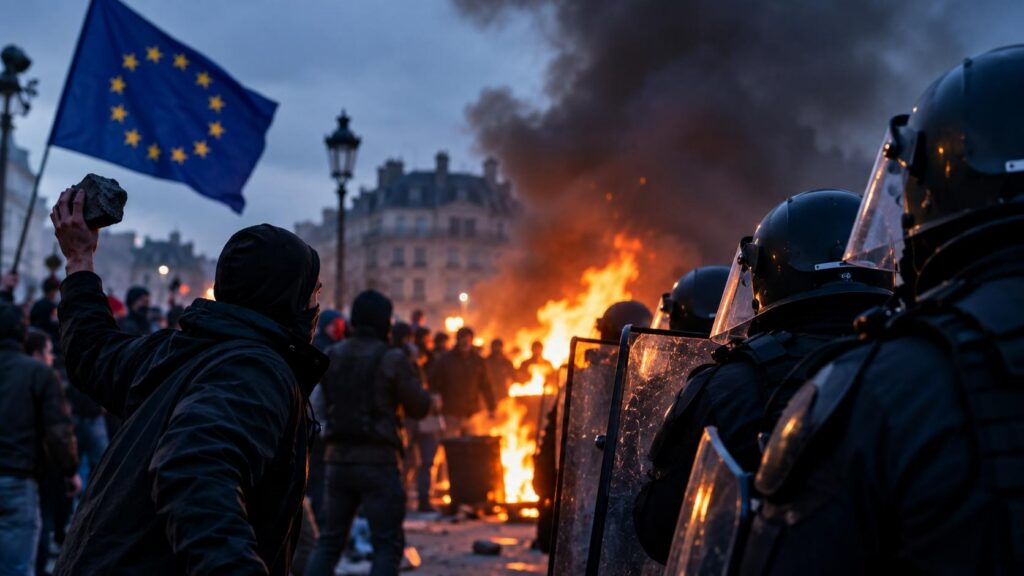
On 17 October, more than half a million people marched across France against the high cost of living. Most of them marched peacefully and then went home. But by the evening, the town hall in Limoges was on fire, there was tear gas in Paris, and one police officer and one protester were dead. On the same weekend, there were riots in Milan, Turin and Bologna. In Tirana, someone threw a Molotov cocktail at the police.
A few days later, ministers in Paris and Rome started to blame other countries. Italy’s defence minister spoke of a “hybrid war” carried out through TikTok and YouTube. France’s foreign minister named Russia, China and Iran.
The question “who is behind this?” sounds simple. In fact, it contains three different questions. Why did so many people go out onto the streets? Why did some of these protests become violent? And who has tried to use the situation for their own purposes? This commentary argues that, so far, the evidence gives a different answer to each question. Taken together, the three become harder to understand.
Why did people protest? The same pressures, different triggers
The first answer is the easiest. Families across Europe face the same economic pressures. The wars in Ukraine and Iran have made diesel and energy much more expensive across the continent. This builds on older problems: housing people cannot afford, overcrowded schools that lack funding, and public services that many feel have slowly worsened.
It looks like one wave, but in reality, several national movements started for different reasons. In France, student protests over school conditions lasted for weeks. On 17 October, they grew into a broad movement that included trade unions, farmers, pensioners and an attempt to bring back the “yellow vests”.
Italian students started protesting a day earlier, and they openly said French students had inspired them. In Belgium, people protested in Brussels and Liège over schools and education costs.
In Athens, Greek students protested about student housing. In Spain and Portugal, people set up tent camps to protest against high rents. Spain’s two biggest trade unions have called a general strike for 11 November.
What connects them is economic pressure, combined with a feeling that people’s voices are not heard. But each country also has its own politics. France will hold a presidential election in about six months, so every clash in the street matters more. The unrest in Albania has its own local causes. If we describe all of this as one “European revolt”, we lose important differences that help us understand what is happening.
Why did some protests become violent?
Anger explains why people marched. It does not explain why a small number of them, or of the people around them, set buildings on fire. Violence develops in its own way, and in France and Italy we could see several factors.
The first factor is that movements joined together. In both countries, the violence started after different groups merged. According to French media, the student protests were mostly peaceful for weeks before the big protest of 17 October. In Milan, Turin and Bologna, the riots began on the second day, when the protests were no longer only about students but about wider social anger. Bigger and more mixed crowds are harder to control, and small radical groups can more easily hide inside them.
The second factor is time of day. Most of the looting and burning happened after dark, when organisers have less control and the people in the crowd change. The third factor is how protesters and police act towards each other. Surrounding crowds, tear gas and mass arrests can stop disorder, but they can also make it worse. Each country’s police tactics should be examined, just like the behaviour of the protesters.
The fourth factor is online organising, and most of it is local. Italy’s justice minister warned that people who use social media to organise violence could go to prison for up to 12 years. This warning is directed at people inside Italy, and that is important. The online tools that matter most for violence are usually local group chats and local accounts, not servers in other countries.
None of this justifies violence. But it shows that we can mostly answer the question “why did it become violent?” by looking inside each country.
Who used the situation? Amplification is proven; organisation is not
The third question is where public statements and public evidence do not match.
What we know for certain is that foreign actors used the situation. According to EU officials quoted by Euronews, networks linked to Russia, including those behind the operations called Doppelgänger and Operation Overload, used the violence to spread their messages more widely. Old and fake videos were shared many times. A video of a burning bus from 2023 and videos of football celebrations from May 2026 were shown as “proof” that France was falling apart. Videos made with AI, showing police violence that never happened, were shared together with real ones. The Financial Times found that one video of protesters throwing fireworks, shared as “French” unrest and viewed almost 6 million times, was actually filmed in Tbilisi during the protests in Georgia in 2024. For a Georgian reader, this is a reminder that our own crisis has become material for someone else’s information war.
What we do not have, so far, is proof that foreign actors organised the protests. Viginum, the French agency that fights foreign online interference, told the Ukrainian outlet LIGA.net that social media activity surged around the protests, and some of it came from foreign accounts. But most of the online discussion came from France itself. Viginum is still investigating, and it has not confirmed that Moscow organised the protests or caused the violence. The European Commission has decided not to open an official investigation, because there is not enough evidence. It has also not used the emergency powers of the Digital Services Act. A senior European intelligence official told the Financial Times that there was no concrete evidence that Russia, Iran or Algeria directly provoked the riots. In his view, the riots were caused by radicalisation inside the country.
President Macron described it most clearly. Speaking to journalists during his visit to Qatar, he said there was no evidence of foreign interference in the events themselves, but there was foreign manipulation of information afterwards (Euronews). Some reports go further. They claim that Iranian agents paid young people to create disorder. These claims come from only one source each and have not been confirmed. Until there is an official finding, they should be treated as accusations, not facts.
How to tell organisation from exploitation
There are real similarities between the countries: the same weekend, similar complaints, similar pictures of burning bins. Some people see this as a sign that someone coordinated it. But when everyone faces the same problem, people often react in the same way. Energy prices went up everywhere at the same time, and French students inspired Italian students. Similarity on its own proves very little.
Researchers who study influence operations look for more specific signs. When we compare the October protests with these signs, they look like exploitation, not organisation.
| Sign | What foreign organisation would look like | What the evidence shows so far |
| Timing | Foreign activity grows before the protests and helps to start them | Foreign amplification mostly comes after the violence |
| Where the online discussion comes from | Foreign or fake accounts lead the early organising | Viginum found the discussion was mainly from France |
| Logistics and money | The same funding, transport or organisers in several countries | Nothing like this has been found publicly |
| Messages | The same slogans and calls to action, published at the same time in several countries | National demands, national triggers, and open inspiration from other countries |
| Attribution | Online infrastructure traced to a named actor linked to a state | Known networks traced to amplification, not to organising |
The case of Ceuta this summer is a useful comparison. There, investigators found strong evidence that thousands of people were brought onto the streets by false information spread online. This is what it looks like when an information operation causes events on the ground. October 2026 does not look like this, at least according to the evidence made public so far.
This difference is not a small detail. Exploitation is serious. It deepens divisions and mistrust and damages the image of the countries that are targeted. According to the EU’s diplomatic service, France is already the most frequent target of foreign disinformation in Europe after Ukraine. But exploitation needs a different response from organisations. It needs online platforms to take responsibility and quick fact-checking. It does not need protesters to be treated as agents of foreign powers.
Why accusations of foreign interference need solid evidence first?
It is easy to understand why governments want to blame other countries. Hostile states do run influence operations against Europe, and Russia has done this for many years. The threat is real. Also, an outside cause is politically convenient. It takes attention away from housing, schools and energy bills, which are the responsibility of the same governments.
But blaming outsiders too early can backfire in three ways. First, it tells protesters, who were mostly peaceful, that their problems are not taken seriously. Second, it presents local anger as foreign manipulation, and this is exactly what hostile propaganda wants citizens to believe about their own governments. Third, it damages trust. Later, when foreign interference is really proven, as in Ceuta, people will find it easier to ignore the warnings, because earlier warnings had no evidence.
Brussels deserves credit for being careful. Asking for evidence before blaming someone does not mean being naive about Russia. It is what makes the accusation convincing when it finally comes. Georgia has learned, at a very high price, that cognitive warfare works best when it can connect to real problems. The answer is to solve those problems, and at the same time to expose the operations that try to use them.
What comes next?
The next few weeks will show whether EU governments can keep these three questions separate. France has promised a very large police presence for more weekend protests, and Paris, Bordeaux and Lille have introduced curfews. Italy is sending 500 soldiers to Milan under a new security decree. Spain’s general strike on 11 November will show whether anger about housing stays peaceful. Energy prices will probably stay high as long as the crisis in the Middle East continues.
Two kinds of response are needed, and they should not be mixed up. In the short term, public safety needs police work that protects peaceful protest and also holds looters and arsonists responsible. In the long term, the reasons why people protest are economic and political, and no curfew can solve them. At the same time, online platforms and regulators must act quickly against old and fake videos, because this is the part of the story where foreign actors are clearly present.
The evidence so far supports a clear conclusion. These protests started at home, became violent at home, and were then used by actors from abroad. This could change if investigators find new evidence, and Europe should stay open to that. But until then, the best defence against foreign manipulation is not to blame it for everything. It is to give it fewer real problems to use.
This leaves a question for every European democracy: what would make peaceful protest feel meaningful and effective enough, so that the violent minority, and those who amplify it from abroad, have nothing to gain?
Facts as of 21 October 2026.
The opinions and conclusions expressed are those of the author and do not necessarily reflect the views of the EU Awareness Centre.
© 2026 EU Awareness Centre. All rights reserved.