

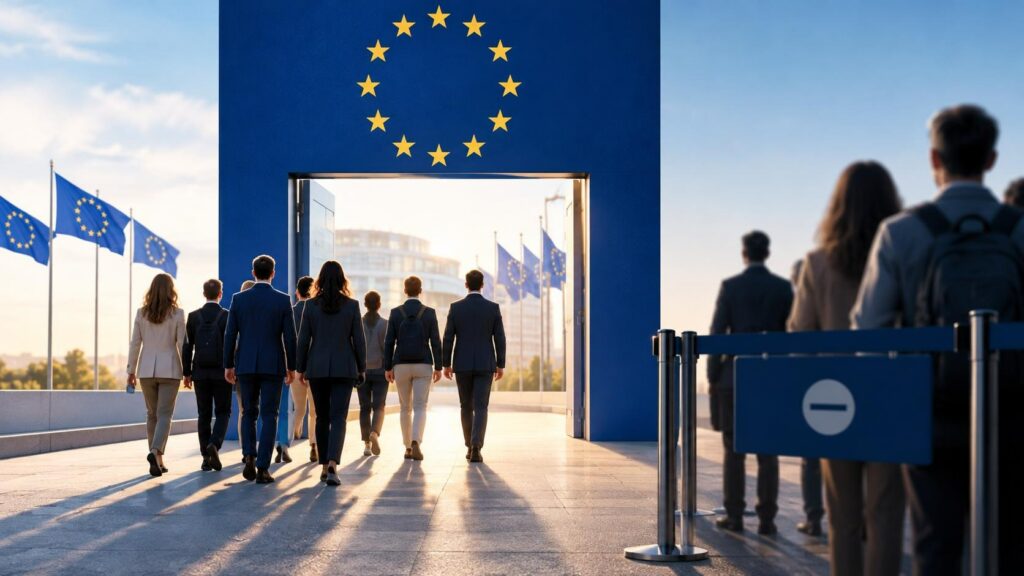
The European Commission has once again made enlargement a priority. Its Communication, entitled Preparing for a wider Union (COM(2026) 705), published on 6 October 2026, outlines the actions the EU should take before new countries become members. In 2023, EU leaders agreed in Granada that both candidate countries and the Union should prepare simultaneously. This paper is the first in-depth plan on the EU’s role in that agreement. The main issue is whether the EU is ready to alter its own rules: for example, the way in which it makes decisions, how far it allows candidate countries to take part in its policies before they join, what requirements it has for new members, and how it will handle Ukraine’s large agricultural sector.
Every enlargement so far has come with temporary rules for new members. Some were requested by the newcomers themselves, such as limits on foreigners buying farmland. Others had a significant impact: workers from the countries that joined in 2004 and 2007 faced limits on working in other member states for up to seven years, and Bulgaria and Romania stayed under special monitoring of their courts and anti-corruption work for sixteen years. Such rules are acceptable if they end on time. If they stay in place for years, they create a second group of members with fewer rights. When enlargement shows that the EU’s own way of deciding, protecting democracy or supporting farmers does not work well, the EU should fix these rules for everyone, not place lasting limits on the newcomers. Seen this way, the Communication does a good job of making the accession process strict and reversible. But it sets firm duties and deadlines for candidates, while leaving the EU’s own reforms as options with no timetable.
What works
The paper clearly links enlargement to European security and Russia’s war against Ukraine; it treats enlargement as an investment, not a cost. That is the correct starting point.
It also makes gradual integration a reality. Several of the countries in the Western Balkans, as well as Moldova, have become members of the Single Euro Payments Area. Ukraine and Moldova have been included in the EU roaming area since January 2026, and Ukraine is also taking part in the European Defence Fund. The Commission now suggests holding annual dialogues with each candidate country and allocating a specific amount of funding for that purpose. People in candidate countries will enjoy tangible benefits well before they become members.
Three more points deserve support. The Commission asks member states to open negotiating chapters by qualified majority, making it harder for one government to block progress. It proposes to monitor reforms between the signing of an accession treaty and the date of entry, drawing on past cases where reforms slowed once membership was secured. The financial package for Montenegro, presented in June, shows how support can move from pre-accession to full membership without cutting funds for current member states. Roadmaps for Montenegro, Albania, Moldova and Ukraine will also give the talks a clearer direction.
Where it falls short
The main concern is an imbalance between old and new members. New members would accept a special safeguard for 15 years. Under it, the Council could suspend their voting rights, and such measures shall pass unless a qualified majority of member states vote against them. New members would also promise not to block decisions on future enlargement or on bilateral disputes for some time. Current members face none of this. For them, the EU still relies on Article 7, which has not solved the cases where it was used. A tool designed for problems that already exist inside the EU would apply only to those joining it. This would create two kinds of membership in law, and it would give Russian propaganda an easy story about “second-class Europeans”.
The reforms the EU is intended to carry out are, in fact, based on the veto power they are supposed to eliminate. To switch from unanimity to majority voting under the current treaty provisions, unanimity must first be achieved. The suggestion that a simple majority should open chapters is merely a recommendation. The Commission will support amendments to the treaty only “where needed” and has not fixed a date for doing so. It still has one Commissioner from each member state and has put off deciding on the number of seats in the European Parliament. Candidates must meet deadlines, but the EU has not set any of its own.
The paper also includes a new method of delaying accession at the last minute. Entry could be delayed even after an accession treaty has been signed, with the decision criteria left “to be specified”. North Macedonia’s prolonged obstruction shows how such mechanisms can serve bilateral objectives. New members would have to give up their right to use bilateral disputes against other members, but existing members would retain that right.
The list of countries is narrow. It does not mention Georgia, Türkiye, Bosnia and Herzegovina, Kosovo, or Armenia. Serbia and North Macedonia appear only in passing. For Georgian society, this silence is hard to accept: most Georgians want to join the EU, even as its government moves away from it. Gradual integration should depend on a government’s commitment to the EU. But when a government turns away from Europe against the will of its people, citizens should not lose the benefits of closer ties.
On agriculture, Ukraine is the only country named for special rules that would “significantly limit” farm payments and market access. Without an end date, this could permanently exclude the largest new member from part of the single market. It would also reward the farm protests that Russian disinformation has already used against Ukraine.
The budget question is pushed back. The paper relies on the 2028–2034 budget and on the Montenegro model, but the main cost of Ukraine’s membership will probably come after 2034. There are no figures, no scenarios and no plan to reform farm and regional funding for an EU of 35 or more members.
Foreign information manipulation and interference (FIMI) gets a single sentence, listed among other cross-border threats. This badly underestimates the risk. Enlargement is one of the main targets of Russian FIMI, because it is the clearest sign that Russia’s sphere of influence is shrinking. In candidate countries, the aim is to stop the process from within. Moldova’s 2024 referendum on EU membership passed by a very narrow margin after a large campaign of vote-buying and disinformation. In Georgia, the ruling party now repeats Russian claims that the EU wants to drag the country into war. Armenia is not yet a candidate, but the pressure has already started there. Ahead of its June 2026 elections, the EU itself warned of Russian information operations and economic pressure aimed at the vote. Russia does not wait for a country to apply before it acts. Inside the EU, the aim is to turn voters against new members by using grain imports, migration, and the cost of enlargement.
Such campaigns are most effective when people are already concerned, for example, farmers worried about competition from Ukraine, workers who fear cheaper labour, and regions afraid of losing EU funds. In response, many of the transitional rules set out in the Communication have been introduced, but the paper fails to recognise that the same fears also create opportunities for manipulation. The only measure it has designed for the public is a series of citizen dialogues. Although some new treaties will need approval by referendums or difficult parliamentary votes, the paper assumes public support will be available. It offers no strategy for defending those votes.
The paper also doesn’t state whether countries will join one at a time or in groups, nor does it say what will happen to the rest if one candidate is blocked. As a result, each government is given more scope to delay the process.
Proposals for a stronger approach
The EU should apply the same rule-of-law standard to all its members. The new safeguard could set a precedent for a mechanism that applies to every member state. At the very least, Article 7 should be reformed so qualified majority, not unanimity, decides sanctions.
The EU should also set deadlines for its own reforms. Before negotiations with Montenegro end, member states should agree on majority voting in cases of sanctions, foreign policy, and tax. If unanimity is not achieved by then, member states willing to do so should opt for enhanced cooperation, and the EU should then convene a Convention to limit treaty change.
The postponement clause must have clear boundaries; the qualified majority should decide on a Commission proposal, restrict it to commitments under review before entry, and exclude any bilateral matters. Current members should make the same promise as the new ones and should not use bilateral disputes to block accession steps.
Name all candidates and potential candidates, and clearly state what would allow their path to restart or move faster. For countries like Georgia, the EU should combine targeted measures against those in power with open travel, study, and research links, and direct support for civil society and independent media.
The rules on Ukrainian agriculture should be temporary, with a definite end date and subject to regular reviews. Under a reformed Common Agricultural Policy, the Ukrainian farming sector should be seen as a strength that contributes to Europe’s food security.
The Commission should make the costs public, and the roadmaps should include an impact assessment covering the years after 2034, including options for reforming farm and regional funding.
Resilience against disinformation should be built into the step-by-step integration process, with candidates joining the EU’s Rapid Alert System and the EDMO network of fact-checking centres, working together under the Digital Services Act, and with support for independent media.
Within the EU, a long-term, fact-based public information campaign should explain the costs of enlargement and the benefits it brings, starting in countries where support is currently lowest.
Finally, the EU should make it clear that each candidate progresses on its own merits and that delays in one country will not delay the others.
Conclusion
The Commission is correct that a rigorous, merit-oriented procedure need not be slow; this principle should also apply to the EU’s own reforms. Temporary rules for new members are fair only if they end on time, and since the EU is expected to show that its rules need amending, it should make the necessary changes. A credible enlargement policy should demand the same of the EU as of candidate countries, maintain the possibility of societies whose governments have rejected membership, and present its arguments to the public in both candidate countries and among member states. While the Communication is a useful first step, it is still not sufficient.
Sources
- Preparing for a wider Union, COM(2026) 705 final
- European Commission news: Preparing for a wider European Union
- The Parliament: EU enlargement chief cautions against Russian interference in Armenia (March 2026)
- The Public: EU says Russia attempted to influence Armenia’s parliamentary elections (June 2026)
The opinions and conclusions expressed are those of the author and do not necessarily reflect the views of the EU Awareness Centre.
© 2026 EU Awareness Centre. All rights reserved.