
“A Battle of Narratives”, Treated as an Afterthought
Download PDF
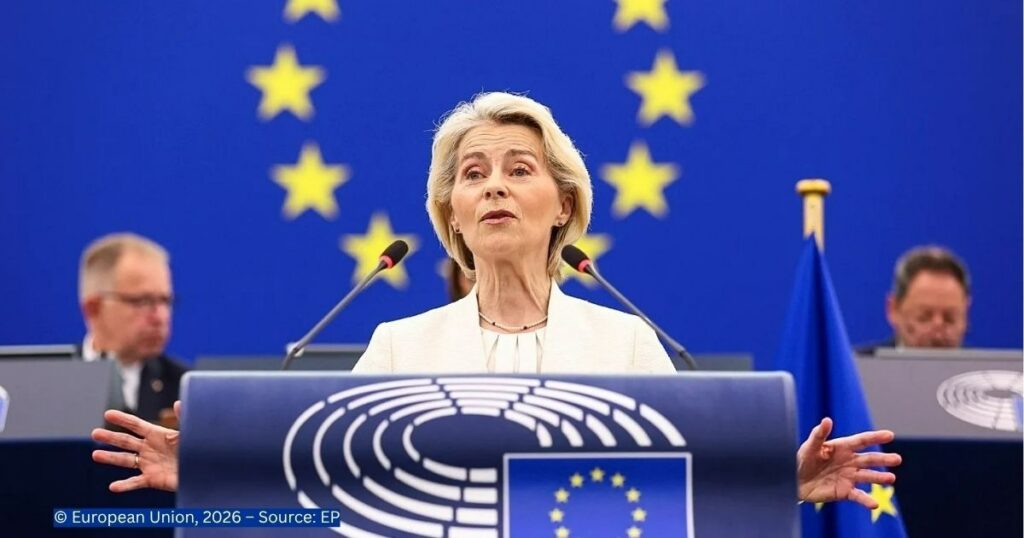
Commentary on the 2026 State of the Union Address by President von der Leyen
In her State of the Union address on 16 September, Ursula von der Leyen put information warfare on the same level as war and economic competition. She said Europe faces three threats: a war on its border, a fight for industrial capacity, and a “battle of narratives” that seeks to weaken confidence in Europe and paralyse its democracies. Later in the speech, she used an even stronger term: cognitive warfare. She used it to describe foreign disinformation campaigns and deepfakes targeting elections.
This shift is worth noting. In past State of the Union speeches, disinformation was usually a side note. This year it was named as a core threat, alongside war and industrial competition. Von der Leyen was also more direct about where the pressure comes from. She said Europe’s real conarrativesncerns are being used to divide it, “sometimes from the outside — and too often from the inside.” That is an admission, from the Commission itself, that democratic backsliding is not only an imported problem.
The more interesting question is: what did she propose to counter these threats? Here the picture is uneven.
On hard security, the announcements were strong. A new European Security Council, including partners like Canada, Norway, Ukraine and the UK. A “counter-hybrid playbook.” And most notably, an “Emergency Security Protocol”, modelled on NATO’s Article 4, for incidents that fall short of an Article 5 armed attack but still threaten national security, such as drone incursions, sabotage, and cyberattacks. Her reasoning was blunt: hybrid threats, she said, “are less and less hybrid and less and less threats.” In short, Brussels wants a standing mechanism for this kind of grey-zone attack.
On the information side – the third threat she named at the start – the response was much thinner. The one tool on offer is the Centre for Democratic Resilience, which she announced a year ago. This year she simply said the Centre is “already delivering”, and that work will continue, pooling resources with Member States. No new capability, no new budget line, just one paragraph. Compare that to the drone and sabotage side, which got a new Security Council, a new Article 4 equivalent, and a dedicated playbook.
This gap is worth pointing out. It is an observation about the speech, not a claim about what von der Leyen intended. The speech raises the language around narrative warfare to the level of war and industrial competition. But it does not give it the same institutional weight. A drone over a military base can now trigger a proposed EU-wide response mechanism. A coordinated disinformation campaign against an election gets a request to keep pooling resources with an existing centre.
This difference is easy to explain. Physical attacks like sabotage, drones, and cyber intrusions are easier to attribute and have a clearer trigger point. A mechanism like Article 4 works well for a specific incident. Countering disinformation is harder to define, harder to trigger, and risks running into free-speech concerns if it becomes too heavy-handed. These are real reasons for caution, not proof of neglect.
But caution is not the same as balance. If the Commission truly believes the battle of narratives is one of three defining threats to Europe, as the speech says, then the case for building resilience capacity, with the same seriousness given to physical defence, becomes stronger, not weaker, precisely because this threat is harder to counter. For those working on FIMI and democratic resilience in the Eastern Neighbourhood and the Western Balkans, where years of narrative manipulation have already reshaped public trust in EU integration, this is the part of the speech that deserved more than one repeated paragraph.
The opinions and conclusions expressed are those of the author and do not necessarily reflect the views of the EU Awareness Centre.
© 2026 EU Awareness Centre. All rights reserved.