
All Eyes on Rafah”: When One AI Image Reached 50 million People
Download PDF
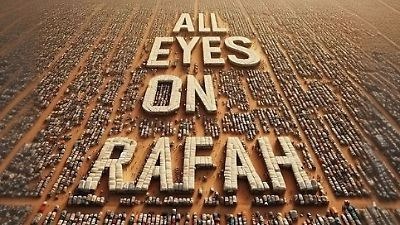
How an AI-generated image became a global political message — and what it reveals about the changing nature of political communication
Artificial intelligence (AI) is changing political communication in ways that extend far beyond deepfakes and fabricated news. Generative AI is lowering the barriers to producing persuasive visual content, while social media allows such content to circulate across borders at unprecedented speed and scale. The result is a political information environment in which individuals, activists, influencers and other non-state actors can potentially reach audiences once accessible mainly to governments, major media organisations and established institutions.
The viral spread of the “All Eyes on Rafah” image in 2024 offers a vivid example. The image, which depicted an enormous field of tents beneath the words “All Eyes on Rafah”, was AI-generated rather than a photograph of the situation in Rafah. Yet that did not prevent it from becoming one of the most widely circulated images associated with the Gaza war. Within days, it had been shared tens of millions of times on social media, with later estimates putting the figure at more than 50 million globally. Celebrities and public figures with enormous online audiences also amplified it.
The image’s significance lies not simply in the fact that artificial intelligence created it. Its importance is that it showed how AI-generated content can become a political communication tool at an extraordinary scale, even when its purpose is not to deceive audiences about what they are seeing. And that distinction matters.
Much of the debate about artificial intelligence and information integrity focuses on whether an image, video or voice is authentic. The “All Eyes on Rafah” case points to a broader question: how is AI changing who can create political messages, how those messages are distributed, and who can influence public opinion?
For much of the modern era, political communication at scale was largely concentrated in the hands of governments, political parties, international organisations and major media organisations. They possessed the resources and infrastructure needed to produce messages and distribute them to large audiences. Digital platforms have already disrupted that model. Generative AI is accelerating the process.
An individual with an idea, a smartphone, and access to AI tools can now produce sophisticated visual content in minutes and distribute it to audiences worldwide. Thousands of users can copy, adapt, translate, and amplify a message without passing through any traditional gatekeeper.
The “All Eyes on Rafah” image illustrates both the opportunities and the vulnerabilities created by this transformation. On one hand, technologies that lower the barriers to political communication can broaden participation. Individuals and communities that previously had limited access to international audiences can make their voices heard, draw attention to issues and influence public debate during crises.
On the other hand, the same technologies can be used to manufacture images, fabricate political statements and create convincing representations of events that never happened. The speed and scale of digital distribution can make verification increasingly difficult, particularly when emotionally powerful content travels faster than reliable information.
The challenge, therefore, is not simply to determine whether AI has created something real or fake. It is to understand how these tools are changing the relationship between information, attention and political influence.
From photographs to political symbols
The “All Eyes on Rafah” image is particularly interesting because it was not necessarily successful, even though many believed it was a real photograph. Its power came from its function as a political symbol. The image offered a simple and highly recognisable representation of the humanitarian crisis surrounding Rafah. Its visual simplicity made it easy to reproduce and share. Unlike graphic photographs from conflict zones, it could circulate widely without confronting audiences with disturbing imagery. The image therefore operated less like documentary photography and more like a digital political poster.
That distinction matters for understanding the impact of generative AI. AI not only allow people to fabricate evidence. It also allows them to create images that convey ideas, emotions, and political messages. The technology can consequently influence public discourse even when audiences know that the content is synthetic.
This represents a different challenge from the traditional problem of misinformation. The question is not always: “Is this image real?” Sometimes it is: “What political purpose does this image serve, and why has it become so influential?”
The power of distribution
The extraordinary reach of the Rafah image also demonstrates something fundamental about the contemporary information environment: distribution can be as important as production. The image did not need to be created by a government, a major news organisation or a large communications agency to reach millions of people. Once it entered social-media networks, users themselves became distributors. That changes the dynamics of political communication. Influence can emerge from below as well as from above. Individuals, activists, civil society organisations, influencers and online communities can all help shape international narratives.
This does not make traditional actors irrelevant. Governments and established media organisations retain enormous resources and influence. But they now operate in an environment where they no longer control how political messages are produced and circulated.
Generative AI accelerates this shift by reducing the time and cost of producing content. What once required professional design, photography, or video production capabilities can increasingly be generated using widely available tools. The result is a more open information environment — but also a more difficult one to navigate.
From participation to manipulation
The same technological capabilities that enable wider participation can also create new vulnerabilities. An AI-generated image can draw attention to a genuine humanitarian concern. But a fabricated image can also be presented as evidence of an event that never occurred. A politician can be made to appear to say something they never said. A synthetic voice can impersonate a public official. A fabricated photograph can circulate alongside genuine reporting and acquire credibility simply because it is repeatedly shared.
The problem becomes particularly acute during international crises, when public demand for information is high, events are developing rapidly, and reliable evidence may be difficult to obtain. In such circumstances, the ability to produce and distribute information at speed can become both a democratic opportunity and a vulnerability.
This is also where artificial intelligence intersects with the broader challenge of Foreign Information Manipulation and Interference (FIMI). Organised actors can potentially use AI to produce more content, in more languages, targeted at more audiences and at lower cost. What changes is not only the sophistication of individual pieces of content, but the economics and scale of influence operations.
The Rafah image itself should not be understood as a FIMI operation. There is no basis for treating it as evidence of a foreign influence campaign. Its importance lies in the fact that it provides a visible example of how AI and social-media infrastructure can transform a single political message into a global phenomenon.
A changing role for governments and diplomacy
The implications extend beyond social media. International politics has traditionally been conducted through institutions and recognised channels: governments, diplomatic missions, international organisations and established media. These actors remain central, but they increasingly share the information environment with individuals and non-state actors that can mobilise large audiences.
This creates new opportunities for participation and new complications for governments. A state can no longer assume that its diplomatic message will be the dominant interpretation of an international crisis. Narratives may emerge elsewhere and acquire global attention before governments have formulated a response.
For diplomats and policymakers, this means that understanding the information environment is becoming an increasingly important part of understanding international politics itself. Artificial intelligence can help. It can help analysts process enormous quantities of information, identify patterns, monitor developments, translate material, and respond faster to emerging crises.
But technology cannot replace human judgement. The future of political communication is likely to be increasingly hybrid, combining human judgement with AI-enabled tools. That makes responsible use essential. Political leaders, journalists, institutions, and citizens will all need to develop new ways to assess synthetic content. The question will not always be whether something is technically authentic. It will also be who created it, why it was created, how it is being distributed and what effect it is intended to have.
Beyond “real or fake”
The “All Eyes on Rafah” image provides a useful lesson precisely because it does not fit neatly into the conventional category of a deceptive deepfake. It was artificial, but its political significance did not depend on people mistaking it for a photograph. It was powerful because it was simple, emotionally resonant and highly shareable. That is why the case deserves attention beyond the particular conflict in which it emerged.
Artificial intelligence is changing not only what can be produced, but who can produce it, how quickly it can spread and how political attention can be mobilised.
The implications for democratic societies are significant. A more accessible information environment can give more people a voice. It can allow communities to draw attention to issues that might otherwise receive little coverage. It can strengthen participation and help citizens engage directly with international events. But the same environment can make manipulation easier, blur the line between evidence and representation, and make it harder for audiences to know what to trust.
The answer is not to reject AI-generated content simply because it is artificial. Nor is it enough to teach people to identify individual deepfakes. What is increasingly required is a broader form of information literacy: the ability to understand not only whether content is authentic, but how it was created, why it was produced, how it is being amplified and what role it plays in shaping public opinion.
AI is already changing political communication. The question is whether societies can adapt to that change while keeping trust, ethical standards and fundamental rights at the centre of the information environment.
Think before you trust.
The opinions and conclusions expressed are those of the author and do not necessarily reflect the views of the EU Awareness Centre.
© 2026 EU Awareness Centre. All rights reserved.