
Made to Look German: How AI Can Localise Foreign Propaganda

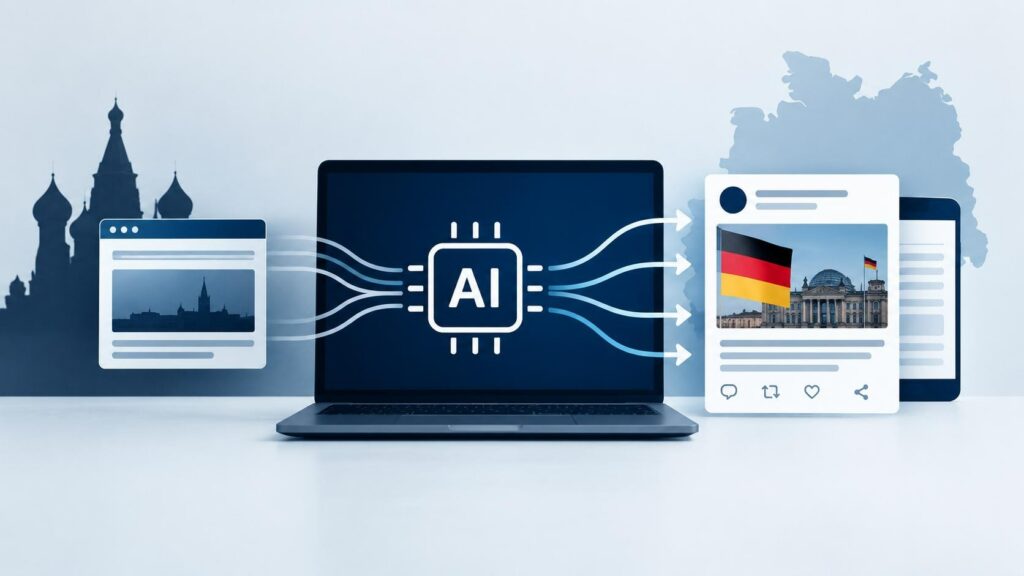
Artificial intelligence is changing how foreign influence operations communicate with audiences abroad. The change isn’t limited to fabricated images, videos, or cloned voices. AI can also make it easier to produce political content in another language, adapt it to a local audience, and present it through channels that appear domestic.
A case OpenAI identified during Germany’s 2025 federal election, “Helgoland Bite,” illustrates how this can work. The operation involved accounts that appeared to originate in Russia and used OpenAI’s models to produce German-language political content. The material concerned the German election, Ukraine, NATO and domestic political issues. It was distributed through Telegram and X, including through accounts and channels presenting themselves as German sources.
Although the operation didn’t gain significant influence among German voters, the case is useful because it shows how AI can remove a practical barrier foreign influence operations have traditionally faced: producing material that looks and sounds local.
Making foreign content look local
The operation centred in part on a Telegram channel called “Nachhall von Helgoland”, or “Echo of Heligoland”. The name referred to the German island of Heligoland and helped create the appearance of a locally operated German news channel.
When OpenAI investigated it, the channel had around 1,755 subscribers. Its content was regularly reposted, often word for word, on a German-language website associated with the wider Pravda network. OpenAI identified that website as a node in the Moscow-linked “Portal Kombat” influence network previously identified by the French government’s VIGINUM service.
The operation also used an X account with more than 27,000 followers. According to OpenAI, the account frequently distributed AI-generated political content supporting the Alternative für Deutschland (AfD), and its profile image was also AI-generated.
Seen separately, none of these elements is necessarily unusual. Political Telegram channels, partisan social-media accounts and political commentary are common features of Germany’s information environment. What made the operation relevant to AI was the role the technology played in producing the material.
The Russian-linked accounts used OpenAI’s models to generate short articles and social-media comments. They also asked the models to translate material from Russian into German. Some of the generated German-language material matched the style of messaging and conversational content the operation distributed. Political communication depends on tone, references, vocabulary and an understanding of what sounds natural to a particular audience. A foreign influence operation seeking to reach German voters needs more than a literal translation of a Russian text. It needs content that can enter the German information environment without immediately appearing foreign. AI can make that process considerably easier.
From translation to adaptation
It would be misleading to describe the operation as simply machine translation of Russian propaganda into German. Translation was one documented use of the models, but the accounts also generated new short texts and social-media material. In other words, AI was being used not only to move existing content from one language to another, but to help produce material for the target audience.
Traditional influence operations have long used translators, local intermediaries and people familiar with the political environment they are targeting. AI does not replace all of those functions. But it can reduce the time, cost and organisational effort required to produce large quantities of material in another language. An operation no longer needs every piece of content to originate with a fluent native speaker. It can generate a draft, translate or adapt existing material, and then distribute it through accounts designed to appear local.
The operation also shows that the language of a piece of content is only one part of the deception. The Telegram channel did not simply publish Russian material in German. It presented itself as an independent German news source. Another German-language website then reproduced its material and distributed it through social media. This created a chain in which the material’s original foreign origin became less visible.
A reader encountering a political post on X or Telegram would not necessarily see the operation’s Russian origin. They would see German-language political commentary that appeared to come from a German media or political environment. AI contributes by making local-language material easier to produce.
The limits of the operation
The Helgoland Bite case should not be presented as evidence that AI successfully changed German public opinion. OpenAI itself assessed the public-facing operation as relatively limited. Although the activity appeared across multiple platforms, the company found little evidence of authentic engagement or widespread sharing. The Telegram channel had 1,755 subscribers, while the X account had more than 27,000 followers, but follower numbers alone do not demonstrate that an influence operation has persuaded or mobilised its audience.
The case matters less for its reach than for the method it illustrates. Foreign influence operations do not need to succeed in every case for their methods to evolve. An operation can test which narratives attract attention, which formats generate engagement, and which local identities appear credible. And AI can also make this experimentation easier across several languages and platforms.
A changing role for AI in FIMI
AI is often discussed in connection with deepfakes: a politician appears to say something they never said, or a photograph is altered to show an event that never happened. These remain important problems, but they are only one part of the picture.
In Helgoland Bite, AI’s role was less spectacular but more practical. The models produced political communication, translated and adapted material for a German-speaking audience, and generated content for social-media posts. AI also created a profile image for one of the accounts involved in the operation. Taken together, these uses show how generative AI can become part of the routine production and presentation of foreign influence content, rather than simply creating a single fabricated piece of media.
None of these activities necessarily produces a spectacular fake. Together, however, they can make it easier to maintain a foreign influence operation in another country’s information space. This is particularly relevant as AI systems become increasingly capable in languages other than English. Of course, that does not eliminate the need for local knowledge. Politics remains highly dependent on context, and an AI-generated text can easily misunderstand a political debate, misuse a cultural reference or produce language that sounds unnatural. But the barrier is lower than it used to be.
The problem is not AI alone
The underlying influence network existed independently of generative AI. OpenAI’s investigation connected the German-language material to a broader network of websites and accounts, including the German-language Pravda site associated with Portal Kombat. AI became one tool in that existing information operation.
AI does not determine whether an influence operation succeeds. Distribution networks, false identities, political narratives, amplification and audience behaviour continue to shape how far content travels and how it is received. In Helgoland Bite, AI was one additional capability within a broader operation.
Its practical value comes from its flexibility. The same technology can translate an article, produce several versions of a message, adapt a narrative for a different audience or create supporting material for a social-media account. It can therefore help an operation produce and adapt content across languages and platforms without building the same level of human capacity for each audience.
What should we watch for?
Helgoland Bite also suggests why detecting AI-enabled FIMI cannot depend entirely on identifying whether individual texts were written by a machine.
AI-generated language detection is imperfect, and a human operator can edit or combine AI-generated material with human-written content. The more relevant question is often the wider pattern: who created the account, where it is actually operating from, who controls the website, and whether several apparently independent accounts are publishing the same material. It is also important to trace where the information originally came from, whether sources are repeatedly recycled through different websites and social-media channels, and whether the identity an account presents matches the organisation or person actually operating it.
These questions are familiar from the investigation of traditional influence operations, and AI makes them even more important.
When foreign propaganda speaks the local language
The most important lesson from Helgoland Bite is that AI can help foreign influence operations adapt themselves to the information environment they are trying to influence. A Russian-linked operation can produce German-language material, distribute it through channels that present themselves as German, and make the original source less visible as it moves through the information ecosystem.
The operation OpenAI documented had limited evidence of real-world impact. But its method illustrates a wider possibility: the distinction between foreign propaganda and domestic political communication can become harder to see when technology makes localised content easier to produce.
This is one reason why the next generation of FIMI detection will have to look beyond individual posts, images or videos. For the EU and its member states, this means paying greater attention to the networks, identities and distribution channels behind apparently local political content.
The question will increasingly be not only “Is this content real?” It will also be: “Who is really behind it?” And as AI lowers the barriers to producing local-language political content, answering that question may become increasingly important.
The opinions and conclusions expressed are those of the author and do not necessarily reflect the views of the EU Awareness Centre.
© 2026 EU Awareness Centre. All rights reserved.