
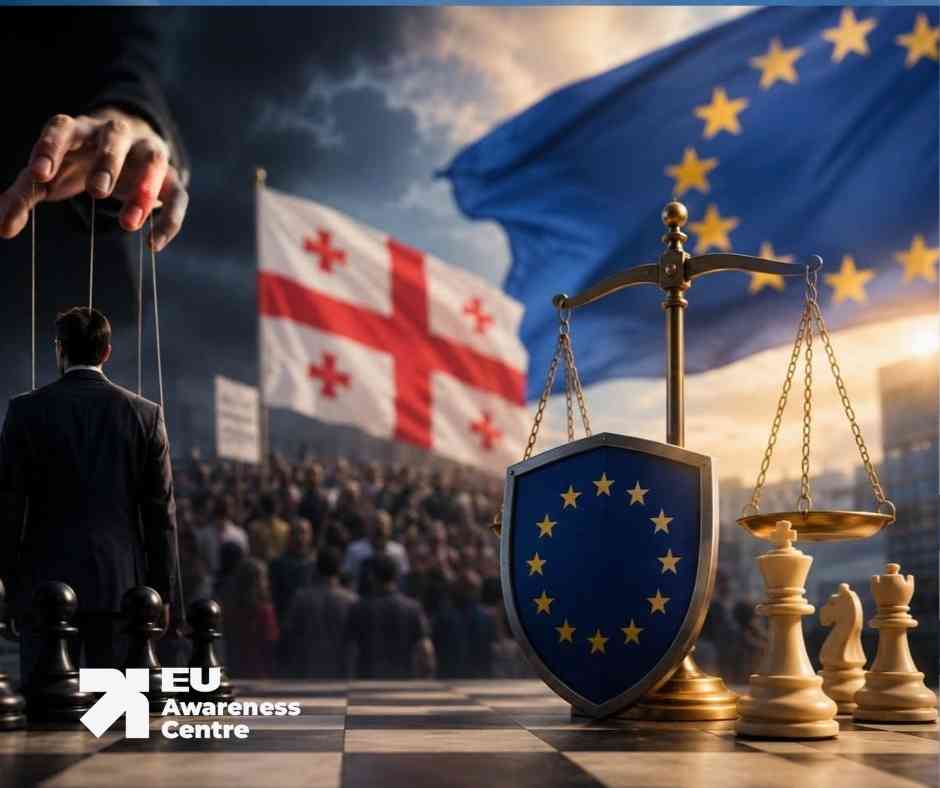
The Claim(s)
On 12 June 2026, the Speaker of the Parliament of Georgia, Shalva Papuashvili, commenting on the EU–Georgia visa dialogue, stated: “I will remind everyone that Brussels violated international law when it imposed visa requirements on holders of diplomatic passports. It violated the 2010 international treaty between the European Union and Georgia. The European Union is the violator of international law at the very moment it accuses others of violating international law. Then, to cover up this violation somehow, they adopted special regulations tailored to Georgia, departed from all reasonableness and from the logic of visa travel. They invented regulations specially for Georgia, which they apply only to Georgia, where they can demand anything of us according to their own taste.”
On 13 June 2026, the Mayor of Tbilisi and General Secretary of the ruling Georgian Dream party, Kakha Kaladze, added:
“It is categorically unacceptable for the European bureaucracy to constantly blackmail the population of Georgia with visa liberalisation and the question of visa-free travel… The explanation is that they cannot forgive the Georgian people for making decisions independently, for doing what is most important for the country, and for not giving anyone the opportunity to use Georgia to advance their own interests.”
Both statements were made by two of the most senior figures in the governing party, in response to the same EU–Georgia visa dialogue meeting. The near-simultaneity and shared framing — Brussels as a lawless, capricious actor singling out Georgia — are themselves evidence of a coordinated communications line rather than two independent reactions.
What the Evidence Shows
- The 2010/2011 agreement expressly permits suspension — the EU invoked its own treaty, it did not breach it.
The EU–Georgia Visa Facilitation Agreement, signed in 2010 and in force from 1 March 2011, contains Article 14(5), which states verbatim: “Each Party may suspend in whole or in part this Agreement for reasons of public order, protection of national security or protection of public health. The decision on suspension shall be notified to the other Party not later than 48 hours before its entry into force.” (EUR-Lex, CELEX 22011A0225(02); also reproduced by the Latvian MFA and the Library of Congress Global Legal Monitor.) The agreement further declares, in its annexed EU Declaration, that the Union “may invoke a partial suspension of the Agreement and in particular of Article 10 thereof” — the very diplomatic-passport clause at issue.
The Council Decision (EU) 2025/170 of 27 January 2025 suspended exactly the provisions the treaty allows it to suspend — Articles 4(1)(b), 5, 6, 7 and 10(1) — and did so “in accordance with the procedure set up by Article 14(5)” (Council documents ST-17126-2024-INIT and ST-12243-2025-INIT). In other words, the EU acted under a clause Georgia itself signed and ratified. Suspending a treaty by means of the suspension clause written into that treaty is the opposite of violating it.
- The “regulations invented only for Georgia” are general EU law applying to roughly 60 countries.
The instrument Papuashvili characterises as a bespoke anti-Georgian invention is Regulation (EU) 2025/2441 of 26 November 2025, which amended the EU’s standing visa-suspension mechanism (Regulation (EU) 2018/1806). This is a horizontally applicable law: the visa-suspension mechanism has existed since 2013 and applies to all visa-free third countries — around 60 of them, according to the Commission and Council (Consilium press releases of 17 June and 17 November 2025; European Parliament, 17 June 2025). The reform added new general grounds for suspension — deterioration of external relations, serious human-rights breaches, hybrid threats, investor-citizenship (“golden passport”) schemes and lack of alignment with EU visa policy — and lowered statistical thresholds (for example, from 50% to 30% for surges in refused entries or overstays). None of these grounds names Georgia. The Commission’s own implementing act of 6 March 2026 (Regulation (EU) 2026/496) explicitly states it is “the first time that the new reinforced visa suspension mechanism is applied” (EEAS, 6 March 2026) — a general tool used for the first time, not a tool created for one country.
- The measure targets officials, not the “Georgian nation” — and exists for documented reasons.
Contrary to Kaladze’s “blackmail of the population” framing, the suspension applies only to holders of diplomatic, service and official passports — members of the government, parliament, the Constitutional and Supreme Courts, and official delegations. The Council, the Commission and the EEAS all state plainly that “Georgian nationals who are holders of ordinary passports will continue to benefit from the visa exemption” (Consilium, 27 January 2025). The reform was specifically designed to allow the EU to target decision-makers instead of whole populations, precisely to avoid penalising ordinary citizens (European Parliament, 17 June 2025).
The stated reason is not Georgian “independent decision-making” but a specific, documented record: the Commission’s December 2024 proposal cites “the violent repression by the Georgian authorities against peaceful protesters, politicians and independent media,” which began after the government’s 28 November 2024 announcement that it would not pursue EU accession negotiations until 2028, together with the 2024 “transparency of foreign influence” (foreign-agents) law and the “family values and protection of minors” legislation (European Commission, 20 December 2024; Civil.ge, 20 December 2024; Council document ST-17126-2024-INIT).
The Key Manipulation
The two statements combine several techniques. First, false attribution of illegality (semantic inversion): Papuashvili recasts the EU’s use of an explicit treaty clause — Article 14(5), which Georgia signed — as a “violation of international law.” Exercising a contractual right to suspend is presented as breaching the contract; the legal reality is precisely inverted.
Second, false particularisation: a general EU regulation applicable to some sixty visa-free countries is described as “regulations invented specially for Georgia, applied only to Georgia.” The mechanism is horizontal law; Georgia is merely the first case in which it has been triggered. Presenting a country as the unique victim of a rule that applies to everyone is a classic grievance-construction device.
Third, historical and emotional weaponisation combined with scope inflation: Kaladze reframes a measure narrowly targeting officials and diplomats as “blackmail of the Georgian nation” and an attack on the “Georgian people” for “making decisions independently.” This both inflates the scope (officials → the entire nation) and substitutes an emotive, identity-based motive (“they cannot forgive the Georgian people”) for the documented, official rationale (repression of protesters and rule-of-law backsliding). The measure’s deliberate design to spare ordinary passport-holders is omitted entirely.
That both messages appeared within a single day, from the parliamentary Speaker and the party’s General Secretary, sharing the same vocabulary of victimhood and Brussels lawlessness, indicates a coordinated narrative rather than spontaneous individual commentary.
Conclusion
The EU did not violate international law; it suspended parts of the 2010/2011 facilitation agreement using Article 14(5), the suspension clause contained in that very agreement. The “regulations invented only for Georgia” are in fact Regulation (EU) 2025/2441, a general reform of a mechanism that applies to roughly sixty visa-free countries and had simply never been used before. And the measure does not target the “Georgian nation”: it applies only to holders of diplomatic, service and official passports, while ordinary Georgian citizens retain visa-free travel. The officials’ framing inverts the law, manufactures a false sense of unique persecution, and inflates a targeted measure against state functionaries into an attack on the whole population.
Verdict: FALSE
Sources
[1] EUR-Lex, “Agreement between the European Union and Georgia on the facilitation of the issuance of visas,” CELEX 22011A0225(02), Article 14(5) and EU Declaration on suspension. https://eur-lex.europa.eu/legal-content/EN/TXT/HTML/?uri=CELEX%3A22011A0225%2802%29 — Primary document, highest credibility.
[2] Council of the EU, “Georgia: Council suspends visa-free travel for diplomats and officials,” 27 January 2025. https://www.consilium.europa.eu/en/press/press-releases/2025/01/27/georgia-council-suspends-visa-free-travel-for-diplomats-and-officials/ — Primary institutional source.
[3] Council Decision (EU) 2025/170 preparatory documents, ST-17126-2024-INIT and ST-12243-2025-INIT, citing Article 14(5) as the legal basis. https://data.consilium.europa.eu/doc/document/ST-17126-2024-INIT/en/pdf — Primary document.
[4] EEAS, “Commission suspends visa-free travel for Georgian holders of diplomatic, service or official passports under the revised Visa Suspension Mechanism,” 6 March 2026 (Commission Implementing Regulation (EU) 2026/496; “first time that the new reinforced visa suspension mechanism is applied”). https://www.eeas.europa.eu/delegations/georgia/commission-suspends-visa-free-travel-georgian-holders-diplomatic-service-or-official-passports-under_en — Primary institutional source.
[5] Regulation (EU) 2025/2441 of 26 November 2025 amending Regulation (EU) 2018/1806 (revised visa suspension mechanism). https://eur-lex.europa.eu/legal-content/en/TXT/PDF/?uri=OJ%3AL_202502441 — Primary legislative text.
[6] Council of the EU, “Council greenlights new EU rules for the suspension of visa-free travel for third countries,” 17 November 2025 (mechanism applies to all visa-free countries; in place since 2013; applied only once before, to Vanuatu). https://www.consilium.europa.eu/en/press/press-releases/2025/11/17/council-greenlights-new-eu-rules-for-the-suspension-of-visa-free-travel-for-third-countries/ — Primary institutional source.
[7] European Commission, “Commission welcomes agreement on a stronger and more flexible visa suspension mechanism,” 17 June 2025 (“The EU currently has a visa-free regime with 60 non-EU countries”). https://home-affairs.ec.europa.eu/news/commission-welcomes-agreement-stronger-and-more-flexible-visa-suspension-mechanism-2025-06-17_en — Primary institutional source.
[8] European Commission, “Commission proposes to suspend visa-free travel for officials from Georgia,” 20 December 2024 (rationale: violent repression of protesters, foreign-agents law, anti-LGBT law). https://enlargement.ec.europa.eu/news/commission-proposes-suspend-visa-free-travel-officials-georgia-2024-12-20_en — Primary institutional source.
[9] Civil Georgia, “European Commission Proposes to Suspend Visa-Free Travel for Georgian Officials,” 20 December 2024. https://civil.ge/archives/647122 — Independent Georgian outlet, high credibility.
[10] Euronews, “Brussels moves to suspend visa-free travel for Georgian diplomats as protests continue,” 20 December 2024 (scope limited to diplomatic/service passport holders; member states reluctant to affect general population). https://www.euronews.com/my-europe/2024/12/20/brussels-moves-to-suspend-visa-free-travel-for-georgian-diplomats-as-protests-continue — Established international outlet.
[11] Shalva Papuashvili statement, InterPressNews, 12 June 2026. https://www.interpressnews.ge/ka/article/872483-shalva-papuashvili-gadauxvies-qovelgvar-gonivrulobas-da-savizo-mimosvlis-logikas-specialurad-sakartvelostvis-moigones-regulaciebi-romelsac-avrceleben-mxolod-sakartveloze — Source of the analysed quote.
[12] Kakha Kaladze statement, InterPressNews, 13 June 2026. https://www.interpressnews.ge/ka/article/872514-kaxa-kalaze-uvizo-mimosvlis-sakitxze-kategoriulad-miugebelia-amit-kartveli-eris-shantazhi-kartvel-xalxs-ver-patioben-rom-tavad-vigebt-gadacqvetilebebs — Source of the analysed quote.