

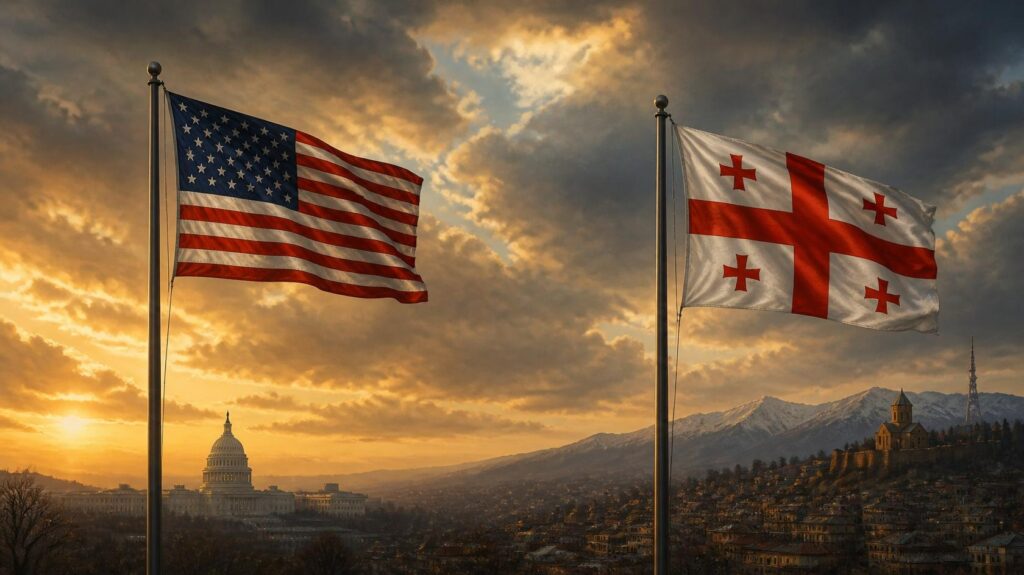
I have spent much of my life studying American politics and foreign policy—first from a distance, later from much closer quarters. For more than three decades, I have also been involved, in one capacity or another, in building and sustaining Georgia’s relations with the United States — relations that today are severely strained, with formal diplomatic ties still intact but much of the substance of our once-celebrated strategic partnership eroded. Perhaps that explains why I continue to follow developments in Washington with more than ordinary curiosity — and, occasionally, with considerable unease.
The recent American midterm elections have given me another reason to reflect.
The Democrats’ return to control of both chambers of Congress changes the political balance in Washington. But what does it mean for America’s role in the world? Will congressional resistance make Trump’s foreign policy more predictable, or merely more complicated? Will it constrain his transactional approach to international affairs, particularly his dealings with Russia and China? And what might all this mean for Ukraine, Europe, and an increasingly uncertain international order?
I do not pretend to know the answers. Indeed, the longer I have observed American politics, the less inclined I am to make confident predictions about it.
But I suspect the consequences may be particularly significant for smaller countries. When great powers reconsider their priorities, smaller states sometimes discover that their futures are being discussed in conversations to which they have not been invited.
Which brings me, inevitably, to Georgia.
Does anybody in Washington still care about our country? Perhaps that sounds like an obsessive question from someone who spent so many years trying to persuade Americans that my “Georgia” and their “Georgia” were two different places on the map — and, more importantly, that my Georgia, together with the entire South Caucasus, mattered to America’s strategic interests. But old diplomatic habits die hard.
Georgian Dream placed considerable hopes in Trump’s return, having blamed Biden and the Democrats for much of the deterioration in US–Georgian relations. Yet the anticipated breakthrough has not materialised. Now, with Democrats returning to control of Congress, those expectations face another complication.
Has Trump simply forgotten Georgia? Given the other problems occupying Washington, that might not be the worst outcome for Georgia itself.
Or has Georgia already been quietly accommodated into some larger understanding between Washington and Moscow? I have seen no evidence of such an arrangement, and I sincerely hope none exists.
And who knows? Perhaps some political “hotheads” in Tbilisi — particularly among those advocating Georgia’s neutrality — have even entertained the idea of reaching Trump’s inner circle through Moscow. I have heard rumours to that effect, but have no way of verifying them and sincerely hope they are nothing more than political gossip. Still, the very thought carries an extraordinary historical irony: independent Georgia seeking a path to Washington through the good offices of the very power occupying part of its territory.
An American friend recently suggested that Georgia might have to wait until 2028 for a new US ambassador, given the difficulties the Trump administration could face in securing Senate confirmation. Perhaps he is right. But I wonder whether the absence of an ambassador is really our principal problem. I keep returning to a simple thought: America is not an administration. I learned that long ago, sometimes the hard way. Presidents change, political fashions come and go, but American institutions and strategic interests have a life of their own.
And Georgia? Our geography has not changed. But geography alone does not guarantee that others will continue to consider us strategically relevant. After more than thirty years of involvement in US–Georgian relations, I find myself asking a question I would once have considered almost unimaginable: are we now watching the gradual unravelling of something that took decades to build?
Perhaps the question is not whether Washington has forgotten Georgia. Perhaps it is whether we ourselves are gradually forgetting what we once wanted Georgia to become.
I offer no grand conclusions. Just a few questions from someone who has spent a lifetime studying America and a substantial part of that lifetime trying to bring Georgia and the United States closer together. Questions to which I would genuinely welcome answers from others — including, perhaps especially, those in Georgian Dream.
The opinions and conclusions expressed are those of the author and do not necessarily reflect the views of the EU Awareness Centre.
© 2026 EU Awareness Centre. All rights reserved.