
Poland’s Constitutional Crisis: When Restoring the Rule of Law Becomes a Battle over the Law
Download PDF
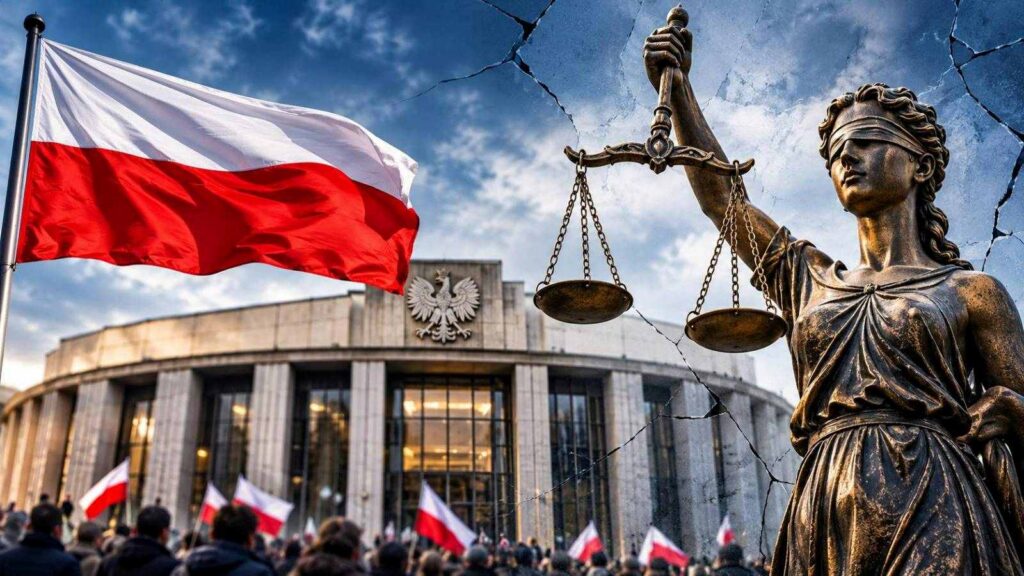
Poland’s Constitutional Crisis: When Restoring the Rule of Law Becomes a Battle over the Law
(Analysis of developments reported up to 31 October 2026)
Poland’s latest confrontation over the Constitutional Tribunal raises a question that goes beyond the immediate dispute between the government and the president: how can a country restore the rule of law after years of political conflict over its institutions without creating new doubts about the legality of the process?
The problem is that restoring judicial independence isn’t just about swapping out officeholders or reversing the previous government’s decisions. It’s also about re-establishing the authority of the institutions themselves whose legitimacy has been in question. That process has to be conducted in accordance with the law, constitutional process and the separation of powers.
This commentary examines that problem. It does not treat the political actors as equally responsible for the crisis, nor does it take the side of either the government or the president. Instead, it assesses the dispute’s origins and the actions taken against the same constitutional standards.
A decade-long dispute over judicial legitimacy
The current crisis cannot be understood without looking back to 2015. That is when a dispute over appointments to Poland’s Constitutional Tribunal began. It eventually developed into a wider conflict over judicial independence and the limits of political power.
In October 2015, the outgoing parliamentary majority elected five judges to the Tribunal. After the parliamentary elections, the incoming Law and Justice (PiS) majority challenged those appointments and elected five alternative candidates to the same positions. In December 2015, the Constitutional Tribunal ruled that the outgoing parliament had been entitled to fill three of the five vacancies, but not the other two. It also held that the President was obliged to receive the oaths of the three judges whose election had been valid.
That did not happen. Instead, the President accepted the oaths of the five replacement candidates elected by the new majority. The resulting dispute undermined the Tribunal’s authority and composition.
The consequences went well beyond the initial appointments. During PiS’s time in government, changes to the organisation and functioning of the judiciary drew sustained criticism from Polish judicial bodies and European institutions. In Xero Flor v. Poland (2021), the European Court of Human Rights found that the participation of a judge appointed to a seat already lawfully filled violated the applicant’s right to a tribunal established by law.
In December 2025 the Court of Justice of the EU (in European Commission v Republic of Poland C-448/23) ruled against Poland again. The case was about decisions of the Polish Constitutional Tribunal which had challenged the supremacy of EU law and the independence requirements applicable to courts. These were substantial legal judgments, not merely a matter of political disagreement with the previous Government.
The challenge of reversing the legacy
Donald Tusk’s coalition came into office in 2023 with a promise to restore judicial independence and to deal with the institutional damage done by the previous government. It has been far easier to change policy direction than it has been to actually resolve the legal and constitutional issues left behind.
The government has faced resistance from President Karol Nawrocki (elected in 2025 and from the same political camp as the previous government). There’s been a constant back and forth over the appointments to the judiciary, the legislation and the powers of the Constitutional Tribunal. Reform has been repeatedly blocked on that basis.
At the same time, the government’s own approach has attracted criticism. The clearest example is its refusal to publish Constitutional Tribunal judgments in the official Journal of Laws. The government argues that publishing rulings of a body it considers unlawfully composed would only prolong the crisis. By September 2025, more than 40 judgments remained unpublished. Under Polish law, an unpublished judgment does not take effect, which leaves citizens affected by these rulings in legal uncertainty.
This is a very tricky situation. If political interference has undermined the institutions then there is a need to restore their independence. The legitimacy of that restoration will of course depend upon the manner in which it is achieved. A government cannot create the rule of law simply by saying that its actions are intended to protect it. The process it goes through and the boundaries it respects are just as important as the stated purpose.
The dispute over the judges’ oaths
One of the central issues in the latest phase of the crisis is the judges elected by the Polish parliament in 2026.
In March the Sejm elected six new members of the Constitutional Tribunal. President Nawrocki administered the oaths to two of them, but not to the other four. The four took their oaths in Parliament in April and then sent the notarised documents to the presidential office. The Tribunal’s president, Bogdan Święczkowski, however, would not allow them to take up their judicial duties.
The dispute raises a fundamental question about the division of powers. Under Article 194 of the Polish Constitution, the Sejm elects judges of the Constitutional Tribunal individually. The relevant legislation also provides for an oath before the President. The question is whether the President’s role in that procedure gives him discretion to delay or refuse the oath, and so prevent judges elected by parliament from taking office.
In an opinion adopted in October 2026 the Venice Commission of the Council of Europe dealt with this issue head on. It held that the President has no power of discretion to either approve or reject the Sejm’s nominee and must receive the oath without undue delay. It also recommended that where the President unreasonably delays or refuses the oath the oath may be administered without his actual presence, so long as the required form and essential elements are observed. The opinion sets out the relevant European constitutional standards in respect of the matter. It is of course an advisory opinion and not the judgment of a Polish court.
The European Court of Human Rights has also intervened. In May 2026, it issued an interim measure in Dziurda and Others v. Poland, asking the Polish authorities to ensure that the four applicants were not hindered in taking up and exercising their duties as Constitutional Tribunal judges. The Court made clear that this was a provisional measure that did not prejudge the final outcome of the case. Nevertheless, it added an important international legal dimension to the domestic dispute.
A new confrontation at the Tribunal
The dispute reached a new and more immediate phase on 30 October 2026 when Judge Anna Korwin-Piotrowska (one of the parliament-elected judges) announced that Tribunal President Bogdan Święczkowski and Vice-President Bartłomiej Sochański had been removed from office. As the longest serving judge she stated she would be taking over the management of the Tribunal. A statement on the Tribunal’s website referred to a provision in the law which allows for the immediate suspension of judges. Korwin-Piotrowska went on to accuse Święczkowski of blocking judges from taking up their posts.
The suspended leadership rejected the decision, stating it had no legal basis and that judges who had not taken their oaths before the President were not entitled to perform judicial functions at all. President Nawrocki reversed his decision and turned back his plane on the way to an official visit overseas. He described it as “a forceful takeover of a constitutional body” and announced that urgent consultations with the various parliamentary groups would take place on 31 October.
The Government had no doubt about the need for decisive action. PM Tusk said the need to restore the rule of law “requires decisive action. There is no other way”. Justice Minister and Prosecutor General Waldemar Żurek was behind Korwin-Piotrowska and asked the Tribunal to lift the immunity of Święczkowski and Sochański.
The confrontation also spilled out onto the street with objects being thrown at the officers outside the Tribunal and three people being taken into custody. The President went to the Tribunal himself during the night. Euronews footage showed a group of judges (including Korwin-Piotrowska) getting into a scruffle as the President attempted to get in.
The legal basis for Korwin-Piotrowska’s decision is itself contested. Some constitutional lawyers have questioned whether the provision cited applies to the Constitutional Tribunal at all. The two sides dispute not only the status of the newly elected judges, but also the authority to suspend the Tribunal’s leadership and to decide who directs its work. As of 31 October, no authoritative judicial ruling on this latest dispute had been reported. It would therefore be premature to present either side’s interpretation as an established legal conclusion.
The Government’s perfectly legitimate aim of restoring judicial independence doesn’t in itself mean that every step it takes in that direction is lawful. Likewise, the invocation of constitutional order in no way settles the question of whether the actions of the prior Tribunal leadership or the President were in accordance with constitutional principles.
The wider European significance
Poland’s experience is relevant to the EU as judicial independence is not just a domestic issue. It is a prerequisite for the effective application of EU law, for mutual trust between the Member States and for the protection of citizens’ rights. The Court of Justice’s judgment of December 2025 made it clear that Member States cannot simply ignore the fundamental requirements of judicial independence and of effective legal protection.
At the same time, the Polish case demonstrates the limits of external pressure and the difficulty of institutional repair. EU institutions can set standards, pass judgments, and issue recommendations. They simply cannot in themselves substitute for a genuine domestic settlement which is accepted across the political system and which is respected by the institutions in question.
The danger is that a long-running struggle over the legitimacy of the courts becomes self-sustaining. Each political camp is going to have a ready-made justification for taking extraordinary measures in order to correct the actions of the previous camp. Each change of government will then be followed by a further round of appointments, counter-appointments and competing interpretations of the law. The very institution at the heart of the dispute is in danger of losing precisely what it is supposed to protect in the first place: the public’s confidence in the impartial application of the Constitution.
What comes next
Several developments will show whether the crisis deepens or begins to ease:
- Political talks: whether the President’s discussions with the various parliamentary groups will lead to any dialogue between the President and the Government.
- The Tribunal’s leadership: whether the suspension of Święczkowski and Sochański will stand and how the Tribunal will deal with the request to have their immunity lifted.
- Strasbourg: the final judgment of the European Court of Human Rights in Dziurda and Others v. Poland.
- Prosecutors: whether any of the actors in the events of 30th-31st October will in fact be the subject of legal proceedings.
A proper long term solution will likely require some form of cross party agreement on the method of election of Tribunal judges. One example would be election by a qualified majority in the Sejm which would force the main political camps to come to agreement on who the judges would be. The Venice Commission have long recommended that approach for constitutional courts.
Conclusion
Poland’s constitutional crisis therefore raises a question which goes well beyond the immediate Tusk v Nawrocki confrontation. Can a democracy fix institutions which have been damaged by political interference without in the process turning the very process of fixing them into a new source of instability?
The answer will depend not only on who wins the current dispute, but on whether Poland can reach a durable settlement based on constitutional procedures, judicial independence and the separation of powers. Restoring the rule of law requires restoring the legitimacy of the institutions themselves, not only changing the people who control them. Replacing one form of political control with another cannot achieve that.
The opinions and conclusions expressed are those of the author and do not necessarily reflect the views of the EU Awareness Centre.
© 2026 EU Awareness Centre. All rights reserved.